There are two kinds of people who book a cruise. The first plans every detail, from cabin category to excursions. The second does all that too, then wonders how to make friends before a cruise and share the experience with the right people.
That second thought is more honest than most travelers admit. A cruise is not a solo hiking trail or a quick city weekend. It is a shared environment designed around togetherness. On a cruise, shared spaces mean the same faces quickly become familiar. The social dimension is not peripheral to the cruise experience. In many respects, it is the experience.
Making friends before a cruise once felt almost contradictory. Today it feels entirely practical. Thousands of cruisers across every demographic — solo adventurers trying to find a cruise partner before embarkation, parents hoping to connect with other families before their kids spend a week feeling out of place, couples wanting to cruise with friends rather than navigating a ship of strangers — now treat the pre-departure social window as a planning stage as deliberate as booking a shore excursion.
What makes that shift possible, and what the evidence says about whether it actually works, is what this piece explores.
Why Before the Ship Matters More Than Anything That Happens Onboard
Onboard social dynamics move faster than most first-time cruisers expect. Within the first 36 to 48 hours of sailing, patterns form. Dining companions are established. The trivia team is assembled. The group that always claims the same corner of the pool deck has claimed it. Solo cruisers often discover the social scene forming before they arrive.
This is not a quirk of cruise culture. It is a function of how humans behave in bounded social environments. Research published in the Journal of Personality and Social Psychology found that in environments where the same group of people share repeated daily contact which is precisely what a cruise ship creates — initial relationship patterns become self-reinforcing within the first two days. The people who connect early accumulate more shared experiences, which leads to deeper connection, which makes the group more cohesive and harder for late arrivals to enter.
The practical implication for anyone who wants to genuinely connect with cruisers is straightforward and slightly counterintuitive. The most important social work of any cruise happens before the ship leaves the dock. A five-minute digital exchange six weeks before boarding does more for your social experience than an hour of confident deck-walking on day three, because it puts you inside that early window rather than knocking on it from the outside.
The 48-hour rule: Social research on bounded group environments — ships, camps, residential programs — consistently finds that connection patterns formed in the first two days persist for the duration of the shared experience. Arriving with even one existing contact effectively resets that clock in your favour.
The more nuanced point is that pre-cruise connection does not replace onboard spontaneity. It enables it. The traveler who arrives knowing a handful of names is not locked into a social schedule — they are freed from the anxiety of needing to manufacture one from scratch. They can still encounter the stranger at the coffee station who becomes a favourite part of the trip. They simply arrive with enough social footing to let those encounters happen naturally rather than desperately.
The Demographic Nobody Writes About: Families, Teenagers, and the Social Stakes of Cruising Together
Almost every piece of writing about cruise social planning focuses on the solo traveler. Understandably so — cruising solo presents the starkest version of the connection problem, and it is the scenario most people imagine when the topic comes up. But the families conversation is at least as important, considerably less explored, and in some ways more emotionally loaded.
When a family boards a cruise ship, the social experience fractures immediately. Parents want relaxation, which on a cruise ship typically means pool time, specialty dining, and perhaps a show or two. Children — and particularly teenagers — want peers. Not their parents’ peers. Not the children of their parents’ friends. Actual contemporaries who share their energy level, their humour, their cultural references. Their complete indifference to the scenic sail-in that their parents are photographing from the railing.
The gap between what parents want from a family cruise. what their teenagers actually experience is one of the most consistent sources of first-day friction in family cruise travel. The teen lounge exists precisely to address this gap, but walking into a room full of strangers when you are fourteen or fifteen years old is not a neutral experience. For many adolescents, it is genuinely intimidating — more so than the equivalent experience for adults, because the social stakes of peer perception feel disproportionately high at that age.
Research published in the Journal of Adolescent Health has documented consistently that adolescents report significantly lower anxiety in new social environments when they have at least one established peer connection present. The effect is not marginal. Teenagers who enter a new group knowing even one person report feeling like insiders rather than outsiders — a perceptual shift that dramatically changes how they engage with the broader group.
The teenager who walks into the ship’s teen lounge already knowing two names from three weeks of online conversation is not entering a room of strangers. They are walking into the continuation of something that has already begun.
What This Means Practically for Families
For parents planning a cruise with teenagers. the single most high-value pre-departure action is helping. their children connect with other young travelers on the same sailing. This is not the same as managing. their social life — most teenagers will bristle at overt parental involvement — but the infrastructure for that connection needs to exist before embarkation.
The same applies to younger children, though the parental role is more direct. Parents who connect with other families before departure find that the shared context — same ship, same dates, often similar ages — creates an unusually easy foundation for friendship that the children inherit by proximity. A parent who has been exchanging excursion ideas with another family for three weeks before sailing does not need to engineer an introduction on day one. It happens before anyone leaves the buffet line.
Cruising with families also unlocks practical coordination that goes well beyond the social. Families who connect before departure can align specialty dining reservations so that children have companions at dinner. They can coordinate excursion bookings to get group pricing. They can establish informal reciprocal arrangements that give each set of parents genuine downtime during the sailing — something that is nearly impossible to organise spontaneously once aboard. When you meet families on cruise sailings in advance, the logistics and the friendship develop together, which makes both more durable.
The Solo Cruiser’s Different Challenge — and Why Pre-Connection Changes the Calculation
For solo cruisers, the pre-connection calculus is different in degree but not in kind. The challenge is not finding peers for a teenager or aligning logistics for a family. It is the more fundamental question of whether a person traveling alone on a ship designed for togetherness will find enough of the right kind of company to make the experience feel full rather than hollow.
Solo travel has grown faster than any other cruise segment over the past decade. CLIA’s 2024 State of the Cruise Industry report documents sustained year-on-year increases in single-passenger bookings, driven by travelers who have actively chosen independence but not isolation. The distinction matters. The solo cruiser does not want to be managed into a group or shepherded through a social program. They want the freedom to choose their company, and they want that company to actually be there when they choose it.
The dining table is where this plays out most visibly. Sitting alone in a main dining room designed around groups of four. six carries a specific social weight. that most solo cruisers experience as disproportionate to its actual significance. Research from the University of Oxford on communal eating found. that shared meals are a more powerful social bonding mechanism. than virtually any other shared activity, including conversation. The solo traveler who dreads the dining room is not being fragile. They are responding to a deeply encoded social signal.
The traveler who arrives with a standing dinner arrangement — even a loose one made through three weeks of digital conversation with another solo cruiser — sidesteps that pressure entirely. The dining table goes from a source of anxiety to a source of connection. That transition, small as it sounds, tends to reframe the entire emotional register of the sailing.
Finding a cruise partner before departure also changes the excursion economics in ways that have real financial significance. According to NerdWallet’s cruise planning guide, private shore tours through independent local operators typically cost 30 to 60 percent less per person than the equivalent ship-sponsored option — but they require a minimum group to make the pricing work. The solo traveler with no pre-existing connections ends up paying ship prices by default. The solo traveler who spent four weeks finding compatible companions pays a fraction of that for a better, smaller, more flexible experience. The economics of pre-cruise social planning are not incidental.
How the Infrastructure for Pre-Cruise Connection Has Changed
The tools available for pre-cruise social planning have evolved considerably over the past twenty years, and understanding that evolution helps clarify which tools serve which purposes — because they are not interchangeable.
The oldest infrastructure is the cruise roll call forum. Platforms like Cruise Critic have hosted sailing-specific communities since the early days of the internet, and those communities remain genuinely valuable for a specific kind of pre-cruise conversation: the broad, information-dense exchange of ship knowledge, port intelligence, and collective cruise experience that only decades of accumulated community expertise can produce. The experienced cruiser who can tell you which deck produces the least vibration, whether the specialty restaurant is worth the surcharge on this particular ship, or what time the port shuttle actually runs is typically found in a roll call forum. That knowledge is not easily replicated elsewhere.
Facebook groups occupy a different position. They move faster, attract more general cruise enthusiasm, and tend to organise the large-format social events — slot pulls, cabin crawls, meet-and-greets for the sail-away party — that require critical mass to work. The trade-off is signal-to-noise: a Facebook group of 400 people on the same sailing also contains 400 people’s opinions about the gratuity policy, the dress code, and whatever controversy the cruise line created this week. For a traveler with a specific social goal — connect with cruisers who share their interests, find a cruise companion for port days, meet people on a cruise who have teenagers the same age as theirs — the volume becomes friction rather than signal.
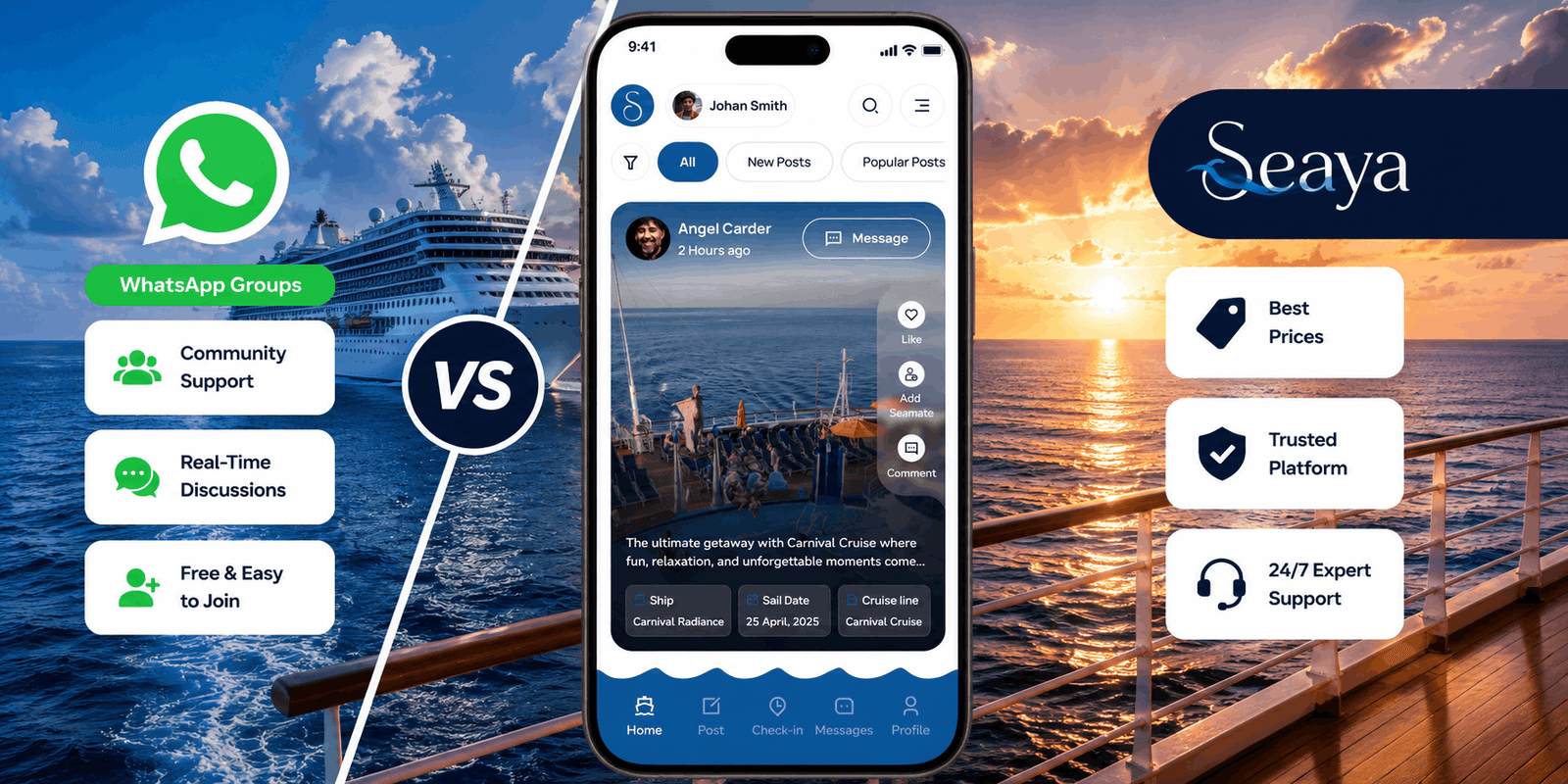
This is where purpose-built platforms serve a genuinely different function. An app designed specifically as a cruise friends app does not try to replicate the community breadth of a forum or the social energy of a Facebook group. It tries to solve the compatibility problem: matching cruisers on the same sailing who share travel style, interests, and social preferences, so that the pre-cruise conversation begins with shared ground rather than having to discover it through weeks of public posts. Seaya is built on exactly this premise — the idea that a cruise companion app should surface relevant people rather than crowds, so that the connection, when it forms, is based on actual compatibility rather than shared embarkation date alone.
The travelers who consistently report the strongest pre-cruise social experiences tend to use all three channels in sequence: roll call forums for ship intelligence, Facebook groups for large-scale social events, and a focused cruise connection platform for intentional one-to-one and small-group matching. Each does something the others cannot.
What Actually Produces Genuine Pre-Cruise Friendships
The research on friendship formation in novel social environments offers some usable guidance that cruise travel content rarely applies directly. A study published in Personal Relationships found that the quality of early social exchanges is a significantly stronger predictor of relationship development than the frequency of contact. In practical terms, this means that one genuine message about a specific shared interest — a port you are both excited about, an excursion you are both considering, a quirky hobby that might generate actual conversation — does more relational work than ten enthusiastic replies to someone else’s post in a group chat.
Being honest about your travel style is also more useful than it might seem. The traveler who describes themselves as an early riser who wants to be off the ship by 8am will naturally find different cruise friends than the traveler who considers a 10am pool deck appearance an early start. Neither preference is better. Both preferences, when expressed clearly before boarding, lead to connections that are actually compatible rather than merely geographically coincident. The cruise carnival friends who end up spending the most time together are usually the ones who were honest about who they were before the ship left port.
The timing question has a reasonably clear answer: four to six weeks before sailing is the productive window. Early enough to allow familiarity to develop through multiple exchanges, late enough that plans remain concrete rather than speculative. Psychology Today’s research on anticipatory social connection notes that shared pre-event anticipation creates a distinct form of social bonding. the excitement of the upcoming experience amplifies the warmth of the connection. because both parties are simultaneously building toward the same moment. The enthusiasm in a pre-cruise conversation is not performative. It is a genuine shared emotion that accelerates the intimacy of the exchange.
The practical architecture of the first in-person meeting also matters more than most guides acknowledge. The sail-away party is an ideal setting for turning online conversations into real introductions.if the in-person chemistry turns out to be different from what the digital exchange suggested. The ship is large enough that nobody needs to feel obligated to continue beyond a friendly wave.
For families specifically: Teenagers arrive more confident when they have chosen their own pre-cruise connections. One whose parents arranged the whole thing will arrive with considerably more ambivalence.
Are Pre-Cruise Friendships Real, or Just Digital Pleasantries That Evaporate Onboard?
Serious doubts about pre-cruise social planning deserve clear answers.
Some pre-cruise connections do not translate. The person behind the messages may not fully match the impression they created. The energy of pre-cruise chats can disappear after embarkation. These situations are normal. travelers should expect them occasionally.
Studies show people often underestimate how enjoyable new social connections can become.
The more honest framing is this: pre-cruise connection is not a guarantee of friendship. It is a significant probability improvement. The traveler who boards with three existing digital connections has three chances for those connections to deepen into genuine friendship. Social circles often form before unconnected travelers settle in.The odds are not remotely equivalent.
And some of the connections do become exactly what they appeared to be during the pre-cruise exchange. The Harvard Study of Adult Development found that relationship quality strongly shapes happiness. A week at sea with people you genuinely connect with is not a trivial contribution to that quality. It is exactly the kind of experience the research identifies as meaningful.
A Note on Safety, Privacy, and Getting the Balance Right
Any good guide balances safety advice without turning fear into the main message.
Cruise social platforms, both forums and dedicated apps, are among the more benign online communities available. Cruise communities tend to feel more authentic because travelers already share a real-world context.
Keep personal details private and arrange first meetings in crowded public spaces onboard. Let the relationship develop at a pace. that reflects the actual level of established trust.
The atrium on embarkation night is ideal for first meetings: public, lively, and naturally brief.
For families, closed cruise communities are usually safer than open social media groups.
The Direction This Is All Moving
Connecting before a cruise is now part of standard trip planning. The trajectory is not reversing.
Cruise lines themselves have acknowledged this shift. Today’s cruise ships are built with intentional social connection in mind. People are not booking cruises despite the social dimension. They are booking them because of it.
The technology supporting pre-cruise connection is following the same trajectory. General forums remain valuable but increasingly serve as reference libraries rather than active social hubs. Facebook groups continue to handle large-scale coordination effectively. And purpose-built platforms like Seaya represent the direction that intentional cruise connection is heading — toward compatibility matching. sailing-specific closed communities.
the kind of structured pre-boarding introduction that removes the cold start entirely.
For families, this changes everything. More teenagers now board cruises already knowing someone their age.
For many travelers, the people onboard shape the cruise as much as the destination itself. Which, when you examine it honestly, is most of them.
So: Can You Really Make Friends Before a Cruise?
Yes — and it works far better than most travelers expect. By the time most travelers think about it, the window is already narrowing.
The framework is not complicated. Start four to six weeks before sailing. Join the roll call or Facebook group for your specific ship and date to get a sense of the community. Then join the wider social conversation.
Then connect through platforms designed around compatibility, not volume. and social energy actually match yours. Be specific about who you are and what you are looking for. Be honest about your travel pace. invest a little time in the digital exchange before boarding. because
that investment pays returns that the cold-start alternative simply cannot match.
For families, the same logic applies with added urgency. For kids and teens, cruise friendships often begin before boarding.
A cruise is a temporary world that disappears when the voyage ends. The relationships that form within it tend to be warm, intense, and disproportionately memorable relative to the time they occupy. Some of them last considerably longer than the voyage. The people who connect best onboard rarely wait for luck
That decision is available to everyone who books a ticket. The only question is whether to make it.

For Christian, Seaya is the culmination of a career-long obsession with innovation. By leveraging his deep technical expertise to dismantle legacy constraints, Christian is transforming the way travelers connect at sea. He is dedicated to keeping Seaya at the vanguard of the “what’s next,” proving that the most powerful innovations happen when world-class tech meets a completely new frontier.
SUBSCRIBE NOW
Your Next Cruise Adventure Awaits
- News & articles
Related Blog