Key Takeaways
- Cruise travel insurance typically costs 4–10% of your total trip cost. The exact price depends on your age, destination, and trip length.
- The most valuable benefits are emergency medical coverage and emergency evacuation. Domestic health insurance rarely covers you once you’re outside the country.
- Trip cancellation and interruption coverage protect the money you’ve already spent. They help if you need to cancel your trip or end your cruise early.
- Common exclusions include pre-existing conditions without a waiver, alcohol-related incidents, high-risk activities, and missing deadlines that were within your control.
- Cruise line insurance is convenient. However, it often provides lower medical and evacuation limits. It may also reimburse cancellations with future cruise credit instead of cash.
- Third-party insurance usually offers higher coverage limits and cash reimbursement. However, you’ll need to compare policies before choosing one.
- International cruises, Alaska cruises, and trips during hurricane season are some of the best reasons to buy travel insurance.
Cruise fares have increased almost every year since the industry’s post-pandemic recovery. The trend continues in 2026. Fuel surcharges, port fees, and premium add-ons all raise the total cost. Many cruise lines also encourage travelers to book upgraded cabins and specialty dining packages. As a result, a family of four can easily spend $3,000 to $8,000 or more on a cruise. When a U.S. Travel Association advisor or checkout page offers travel insurance for $189, it’s natural to hesitate. Is it a smart investment or just another upsell?
By the end of this guide, you’ll know whether cruise travel insurance is worth buying. You won’t have to rely on guesswork. You’ll also learn how it fits into your overall pre-cruise planning. That includes more than just insurance. It also covers practical tips, such as meeting fellow passengers before you even board.
What Is Cruise Travel Insurance?
Cruise travel insurance helps protect the money you’ve invested in your trip. It also covers risks that regular health insurance or homeowners insurance usually doesn’t cover. This is especially important once you leave home or sail in international waters.
It’s not one single benefit. It’s a bundle of coverages, and understanding each piece helps you figure out which ones actually matter for your trip.
Trip cancellation reimburses your prepaid, non-refundable cruise costs if you cancel before departure for a covered reason. Common reasons include a sudden illness, job loss, or a death in the family.
Trip interruption applies after your trip has started. If you need to leave the ship early or delay your return for a covered reason, it reimburses the unused portion of your cruise. Many policies also cover the cost of getting home.
Emergency medical coverage pays for treatment if you become sick or injured during your cruise. This benefit is more important than many travelers realize. Most U.S. health insurance plans, including Medicare, provide little or no coverage outside the country. A cruise ship’s medical center is generally treated as being outside the country, even when the ship is docked at a U.S. port.
Emergency evacuation covers the cost of transporting you to the nearest suitable medical facility. On a cruise, this may involve a helicopter or a private medical flight. Without insurance, these evacuations can cost $25,000 to more than $100,000.
Coverage varies from one policy to another. Not every plan includes the same benefits or coverage limits. That’s why comparing policies is more important than choosing the first option offered during checkout.
Do You Really Need Cruise Travel Insurance?
There’s no universal answer here, and anyone who tells you insurance is always essential — or always a waste of money — is oversimplifying.
Insurance tends to make sense when:
- Your cruise fare is largely non-refundable and represents real money you can’t easily absorb if lost
- You’re traveling internationally, where your domestic health insurance likely won’t help you
- You have a health condition, or you’re traveling with someone who does, that could realistically disrupt travel plans
- You’re cruising during a season with elevated weather risk, like hurricane season in the Caribbean
- You booked far in advance and life circumstances could reasonably change before departure
- You’re an older traveler, since medical evacuation risk and cancellation risk both increase with age
Insurance may be less critical when:
- Your cruise is fully refundable or low-cost enough that losing it wouldn’t be a financial hardship
- You already have annual travel insurance or credit card travel protections that cover the trip adequately
- You’re taking a short, domestic, close-to-home cruise (like a quick West Coast or repositioning cruise) with minimal financial exposure
- You’re young, healthy, and have flexible plans with a low likelihood of cancellation
The honest truth is that travel insurance is a risk-management decision, not a moral one. You’re weighing the cost of the policy against the financial exposure you’d face without it. For many cruisers, especially those sailing internationally or spending several thousand dollars on a trip, the math tends to favor buying a policy. For others, it genuinely doesn’t.
What Does Cruise Insurance Cover?
Let’s look more closely at what each major type of coverage means in real life. Terms like trip cancellation and emergency medical coverage sound simple until you need to file a claim.
Trip cancellation example: Imagine you paid $4,200 for a seven-night Caribbean cruise. Three weeks before departure, your father is hospitalized. If your policy covers that situation, it can reimburse your prepaid cruise fare. Most standard policies cover events such as illness, injury, or death. They do not cover canceling simply because you changed your mind.
Trip interruption example: You’re two days into a Mediterranean cruise when you develop appendicitis. You must leave the ship in Barcelona for surgery. Trip interruption coverage can reimburse the unused portion of your cruise. It may also pay for your flight home once you’re medically cleared. Emergency medical coverage can help pay for the hospital treatment.
Emergency medical example: A minor injury on the pool deck may only require a visit to the ship’s medical center. Even a basic consultation can cost $200–$500. More serious emergencies, such as a heart problem or a severe fall, can cost thousands of dollars. Those expenses can add up before evacuation is even considered.
Emergency evacuation example: Imagine you’re crossing the Atlantic and need medical care the ship cannot provide. You may need a helicopter transfer to the nearest hospital. A private medical flight home could also be required. Emergency evacuation coverage helps pay these costs. Many experienced cruisers consider it the most valuable part of a travel insurance policy because evacuation expenses can easily reach six figures.
What Cruise Insurance Does NOT Cover
Just as important as knowing what’s covered is knowing what isn’t — this is where a lot of travelers get an unpleasant surprise at claim time.
Pre-existing medical conditions. Most standard policies exclude conditions you were already being treated for before you bought the policy, unless you purchase the plan within a specific window after your initial trip deposit (often 14–21 days) and meet a “waiver” requirement. If you have a known condition, this timing detail matters enormously.
Alcohol- and drug-related incidents. If an injury occurs while you’re intoxicated, most policies will deny the claim outright.
High-risk or excluded activities. Certain adventure activities — some scuba diving beyond recreational limits, cliff jumping, and similar excursions — may be excluded unless you add a specific rider.
Missed deadlines you control. If you simply oversleep and miss the ship’s all-aboard time while you’re already in port, that’s generally on you, not the insurer — this is different from missing the ship’s initial embarkation due to a covered travel delay.
Documentation and paperwork issues. Forgetting your passport, letting it expire, or failing a destination’s entry requirements is not a covered reason for cancellation or interruption.
“Cancel for any reason” without the add-on. Standard trip cancellation only reimburses for specific listed reasons. If you simply change your mind, you need a “Cancel for Any Reason” (CFAR) upgrade, which usually only reimburses 50–75% of your trip cost and must be purchased early, typically within 14–21 days of your first trip payment.
Known risks at time of purchase. If a hurricane is already named and tracking toward your destination when you buy the policy, cancellation related to that specific storm generally won’t be covered — this is why buying early matters.
Cruise Line Insurance vs Third-Party Insurance
One of the biggest decisions cruisers face is whether to buy the “Cruise Care” or “Vacation Protection” plan offered directly by the cruise line at checkout, or to shop a third-party travel insurance provider instead. Both have real advantages.
| Factor | Cruise Line Insurance | Third-Party Insurance |
| Convenience | Very high — added at checkout | Requires a separate purchase and comparison |
| Price | Often bundled at a flat rate regardless of age | Usually priced by age, trip cost, and destination |
| Medical coverage | Typically lower limits ($10,000–$25,000) | Often much higher limits ($50,000–$500,000+) |
| Evacuation coverage | Sometimes limited or bundled with medical | Usually a separate, higher benefit ($100,000–$1,000,000) |
| Cancellation reimbursement | Frequently offered as “Cancel for Any Reason” credit (future cruise credit, not cash) | Often full cash reimbursement for covered reasons |
| Pre-existing condition waiver | Easier timing window in some cases | Available but with stricter timing requirements |
| Customer service | Handled through the cruise line | Handled by a dedicated insurance claims team |
| Flexibility | Limited to what the cruise line offers | Wide range of plan tiers and add-ons |
| Best for | Travelers who want simplicity and don’t mind future cruise credit over cash | Travelers who want stronger medical/evacuation protection and cash reimbursement |
Pros of cruise line insurance: simple to add, no separate shopping required, and cancellation often converts to a future cruise credit that’s easy to redeem if you sail with that line again.
Cons of cruise line insurance: medical and evacuation limits are often lower than what a dedicated travel insurer offers, and “cancel for any reason” benefits frequently pay out in cruise credit rather than cash.
For a short, inexpensive domestic cruise, cruise line insurance is often “good enough.” For an expensive, international, or medically higher-risk trip, most independent travel advisors and experienced cruisers recommend comparing at least two or three third-party quotes before defaulting to what’s offered at checkout.
How Much Does Cruise Insurance Cost in 2026?
As a general rule of thumb, cruise travel insurance costs 4% to 10% of your total trip cost, though the exact number depends on several factors.
Average cost ranges in 2026:
- A $2,000 cruise: roughly $80–$180 per person
- A $5,000 cruise: roughly $200–$450 per person
- A $10,000+ luxury or world cruise: roughly $500–$1,200+ per person, especially with higher medical/evacuation limits or a CFAR upgrade
Factors that affect your quote:
Age. This is the single biggest factor. Travelers over 65 or 70 often see premiums double or triple compared to a traveler in their 30s, largely because medical and evacuation claim risk rises with age.
Destination. Cruises to remote or higher-risk regions (certain expedition cruises, some international itineraries) can cost more to insure than a standard Caribbean sailing.
Trip length. Longer cruises mean more days of potential medical or interruption risk, which increases the premium.
Total trip cost. Since cancellation coverage is based on reimbursing what you paid, insuring a $12,000 suite costs more than insuring a $1,500 interior cabin.
Add-ons. Cancel for Any Reason, “cancel for work reason,” rental car coverage, and higher medical/evacuation limits all add to the base premium.
When Is Cruise Travel Insurance Worth It?
Some scenarios make the case for insurance especially strong. Here’s where most experienced cruisers and independent advisors agree it’s worth the cost.
International cruises. Once you leave U.S. waters, your domestic health insurance and Medicare typically won’t help you, making emergency medical and evacuation coverage genuinely valuable.
Alaska cruises. Remote itineraries with limited nearby medical infrastructure make evacuation coverage particularly important — a medical emergency in Glacier Bay is a very different situation than one docked in Miami.
European cruises. Higher trip costs, longer flights, and more complex logistics if something goes wrong all raise the value of a solid policy.
Hurricane season sailings (June–November in the Caribbean/Atlantic). Buying early — before a storm is named — protects you if your embarkation port or itinerary is disrupted.
Expensive or luxury cruises. The more money on the line, the more a cancellation or interruption benefit protects.
Family cruises. More travelers means more variables — a sick child, a work emergency for a parent — that could force a cancellation or early return.
Senior travelers. Higher medical risk and often higher trip costs (many seniors book suites or longer itineraries) make coverage more valuable, even though premiums are higher too.
Traveling with children. Kids get sick unpredictably, and school and pediatrician schedules can create last-minute conflicts that threaten a planned trip.
When Might You Skip Cruise Insurance?
Being balanced means acknowledging that insurance isn’t always the right call.
- Short, inexpensive, domestic cruises where the financial exposure is genuinely low
- Fully refundable bookings, where cancellation risk is already covered by the cruise line’s own policy
- Travelers who already have an annual travel medical/evacuation plan that covers cruises specifically (read the fine print — not all annual plans do)
- Travelers with strong, flexible credit card travel protections that already include trip cancellation/interruption and emergency medical evacuation for cruise bookings paid on that card
- Very healthy, young travelers with highly stable plans and minimal risk of needing to cancel
If none of the “worth it” scenarios above apply to you, it’s entirely reasonable to skip a policy or to buy only a lighter, cheaper plan focused on medical/evacuation rather than full cancellation coverage.
Best Cruise Insurance Providers in 2026
Rather than pushing one “best” answer, here’s an honest look at how different types of providers tend to compare. Always confirm current pricing and benefit limits directly with the provider before buying, since plans are updated regularly.
Large, well-established travel insurers (the Allianz/Travel Guard/Seven Corners tier of the market)
- Pros: Long claims-history track record, widely accepted by cruise lines, broad plan tiers
- Cons: Pricing can run higher than newer entrants; some plans have more exclusions in the fine print
- Best for: Travelers who prioritize a well-known name and extensive customer service infrastructure
Comparison marketplaces (sites like Squaremouth or InsureMyTrip that let you compare multiple insurers at once)
- Pros: Fast side-by-side comparison of dozens of plans, filter by coverage type and price
- Cons: You’re still choosing among third-party underwriters, so read each plan’s actual policy document, not just the summary
- Best for: Travelers who want to comparison-shop efficiently instead of visiting multiple insurer sites
Newer, tech-forward insurers (companies like Faye or similar app-based insurers)
- Pros: Often faster digital claims processing, modern app experience, competitive pricing for younger travelers
- Cons: Shorter track record, fewer legacy underwriting partnerships in some regions
- Best for: Tech-comfortable travelers who value a fast claims process and don’t need decades of brand history
Cruise-line-branded plans
- Pros: Maximum convenience, easy to bundle with your booking
- Cons: Often lower medical/evacuation limits, cancellation benefits frequently paid as cruise credit rather than cash
- Best for: Lower-cost, domestic, or short cruises where simplicity outweighs maximizing coverage limits
The most reliable approach is to request quotes from at least two or three providers, compare the actual medical and evacuation limits (not just the headline price), and read the pre-existing condition exclusion language carefully if it applies to you.
Common Cruise Insurance Mistakes
Even well-intentioned travelers make avoidable errors when buying cruise insurance.
Buying too late. Many of the best benefits — CFAR, pre-existing condition waivers, hurricane protection before a storm is named — require purchasing your policy within a specific window (often 14–21 days) of your first trip deposit. Wait too long and you lose access to these upgrades entirely.
Not reading the exclusions. The list of what’s not covered is often longer and more important than the marketing copy about what is covered. Always read the actual policy document, not just the sales page.
Choosing the cheapest plan by default. A rock-bottom price often means lower medical and evacuation limits — exactly the benefits that matter most in a real emergency.
Ignoring medical evacuation limits. A plan with strong cancellation coverage but only a $25,000 evacuation limit can leave you dangerously underinsured if a real evacuation is needed.
Not covering your flights. If your cruise and flights are booked separately, make sure your policy actually protects your air travel too — some plans only cover the cruise portion unless flights are added explicitly.
Assuming your credit card covers everything. Many premium travel credit cards offer some trip protection, but the limits are often lower than a dedicated policy, and coverage sometimes excludes cruises specifically or has narrower cancellation reasons. Check the benefits guide, don’t assume.
Expert Tips Before Buying Cruise Insurance
- Buy within the early window (14–21 days of your deposit) if you want CFAR or a pre-existing condition waiver — this is the single most time-sensitive tip.
- Compare medical and evacuation limits first, then compare price — a cheap plan with weak medical coverage isn’t actually a good deal.
- Insure 100% of your trip cost, not a partial amount, or your cancellation reimbursement will be capped below what you actually paid.
- Check whether your policy covers “cruise-specific” scenarios like missed embarkation and itinerary changes — not every general travel policy does.
- Read the pre-existing condition clause closely if it applies to you or a traveling companion; the definition of “look-back period” varies by insurer.
- Keep documentation — receipts, medical records, correspondence — from the moment anything goes wrong, since claims are far easier to process with solid paperwork.
- Consider a family/multi-trip annual plan if you cruise more than once a year — it’s often cheaper than buying single-trip policies each time.
- Call the insurer’s claims line number, not just customer service, and save it somewhere accessible before you sail, so you’re not searching for it mid-emergency.
How Seaya Helps Before Your Cruise
Insurance is one piece of preparing for a cruise, but it’s rarely the part people actually look forward to. Once travelers have their coverage sorted — insurance purchased, documents in order, packing list underway — a lot of the enjoyable pre-cruise planning still lies ahead, and that’s where many cruisers turn to Seaya.
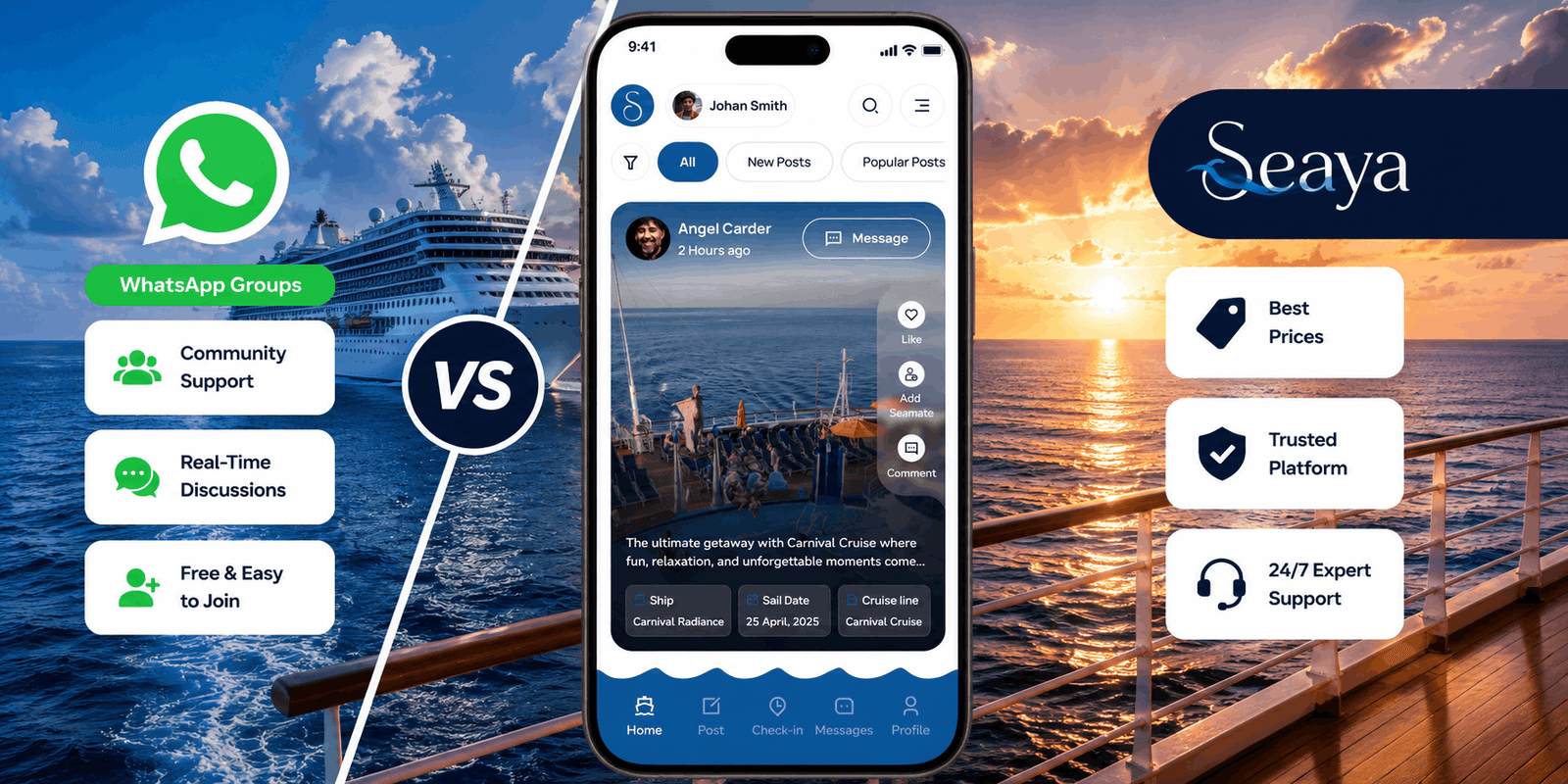
Seaya is built around the idea that a cruise starts before you ever step onboard. Instead of meeting your entire Roll Call or dinner table for the first time at the dock, Seaya lets you connect with other passengers booked on your same sailing ahead of time — so you can coordinate shore excursions together, split the cost of a private tour, or simply know a few friendly faces before the ship even leaves port.
For travelers who’ve just spent time thinking carefully about protecting their trip financially and medically, Seaya rounds out the picture by helping you get more value out of the trip itself: better group excursion planning, more people to share tips with about your specific ship and itinerary, and a stronger sense of community from day one. It’s a natural next step once the practical planning — insurance included — is behind you.
FAQs
Is cruise insurance worth buying?
For most travelers taking an international, expensive, or higher-risk cruise, yes — the emergency medical and evacuation benefits alone often justify the cost. For short, low-cost, or fully refundable domestic cruises, it’s a more optional decision.
Do cruises require travel insurance?
No cruise line requires you to purchase insurance to sail, though some destinations have their own entry health-coverage requirements you should check separately.
Does my credit card include cruise insurance?
Some premium travel credit cards include limited trip cancellation, interruption, or medical benefits, but the coverage limits are often lower than a dedicated travel insurance policy, and not every card covers cruises the same way it covers flights or hotels. Check your card’s benefits guide directly.
What happens if I cancel my cruise?
Without insurance, you’ll typically lose some or all of your prepaid cruise fare depending on the cruise line’s cancellation penalty schedule. With a covered trip cancellation policy, you can be reimbursed for a covered reason, minus any exclusions in your specific plan.
Does cruise insurance cover hurricanes?
Many policies cover hurricane-related cancellations and interruptions, but only if you purchased the policy before the storm was named or the risk was publicly known. Buying early in hurricane season protects this benefit.
Does cruise insurance cover COVID-19?
Most current policies treat COVID-19 like any other covered illness for trip cancellation and medical benefits, but coverage specifics vary by insurer, so confirm the current policy wording rather than assuming based on older pandemic-era plans.
Can I buy cruise insurance after booking?
Yes, most policies can be purchased any time before your final trip payment or departure, but certain valuable add-ons — Cancel for Any Reason and pre-existing condition waivers — usually require purchase within 14–21 days of your initial deposit.

For Christian, Seaya is the culmination of a career-long obsession with innovation. By leveraging his deep technical expertise to dismantle legacy constraints, Christian is transforming the way travelers connect at sea. He is dedicated to keeping Seaya at the vanguard of the “what’s next,” proving that the most powerful innovations happen when world-class tech meets a completely new frontier.
SUBSCRIBE NOW
Your Next Cruise Adventure Awaits
- News & articles
Related Blog