Stepping onto a massive cruise ship should feel like the ultimate social catalyst. You’re surrounded by thousands of people sharing the same itinerary, the same sunsets. The same lobster tail at the formal dinner. And yet, for an enormous number of travelers, a strange paradox quietly takes hold. Despite being on a literal floating city, striking up a real conversation feels incredibly difficult.
The expectation of effortless friendship rarely survives contact with reality. Whether you’re sailing solo, traveling with your family, or part of a large group, the social dynamics on a modern cruise ship are more complicated than they look from the outside. Understanding why that friction exists is the first real step toward doing something about it.
The “Transient Crowd” Problem That Nobody Warns You About
With five thousand passengers onboard, you might expect to bump into interesting people constantly. In practice, the sheer scale of a megaship works against you. You see a friendly face at the buffet and share a laugh, but with dozens of venues spread across fifteen decks, you may genuinely never cross paths with that person again. The brain registers this reality and quietly responds by pulling back. Why invest energy in a connection that evaporates in forty-eight hours?
This is what researchers sometimes call the “transient crowd” effect — a subconscious hesitation that kicks in when the social environment feels too large and too temporary to be worth navigating. It isn’t shyness. It isn’t introversion. It’s a rational, if unfortunate, response to the environment you’re in. For anyone genuinely hoping to meet people on a cruise, this psychological undercurrent is the first wall to be aware of.
The Invisible Walls of Group Travel
If you’re cruising with family or a group of friends, you might assume the social pressure is off. But group travel creates its own distinct barrier. From the outside, a laughing table of six looks like a closed unit. Other passengers — including solo travelers actively looking for How to make friends on a cruise — often won’t approach a group that seems self-contained. They don’t want to intrude.
Inside the group, something equally limiting happens. When your immediate social needs are already being met by your companions, the instinct to look outward disappears. Days pass, ports come and go, and you realise you haven’t learned the name of a single person outside your own cabin. This isn’t a failure of character — it’s just how comfortable social bubbles work. They keep you warm and they keep you closed.
There’s also the structural reality of modern dining. Traditional cruise dining used to force interaction through assigned communal tables, where a honeymoon couple and a retired professor from Ohio would find themselves sharing bread rolls and swapping life stories. The shift to “anytime dining” — where most ships now seat you at a private table for two on request — has quietly removed one of the most organic engines of shipboard friendship. Without those forced moments, the entire burden of sociability falls on the individual.
How Ship Architecture Quietly Works Against You
Modern cruise ships are marvels of engineering, but they weren’t designed with spontaneous human connection in mind. Balcony cabins face the ocean rather than each other. The lido deck arranges sunbathers in forward-facing rows, headphones in, eyes on the horizon. A ship with twelve bars and four pool areas sounds like a socializer’s paradise until you realise it means the passenger population is constantly diluted across a dozen different spaces.
This “social density” problem is real. It’s much harder to bump into the same person twice when there are ten different places to get a morning coffee. Anyone trying to figure out how to make friends on a cruise ship has to be far more intentional than the brochure implies. You genuinely cannot wait for luck to do the work for you.
The Pressure to Perform Happiness
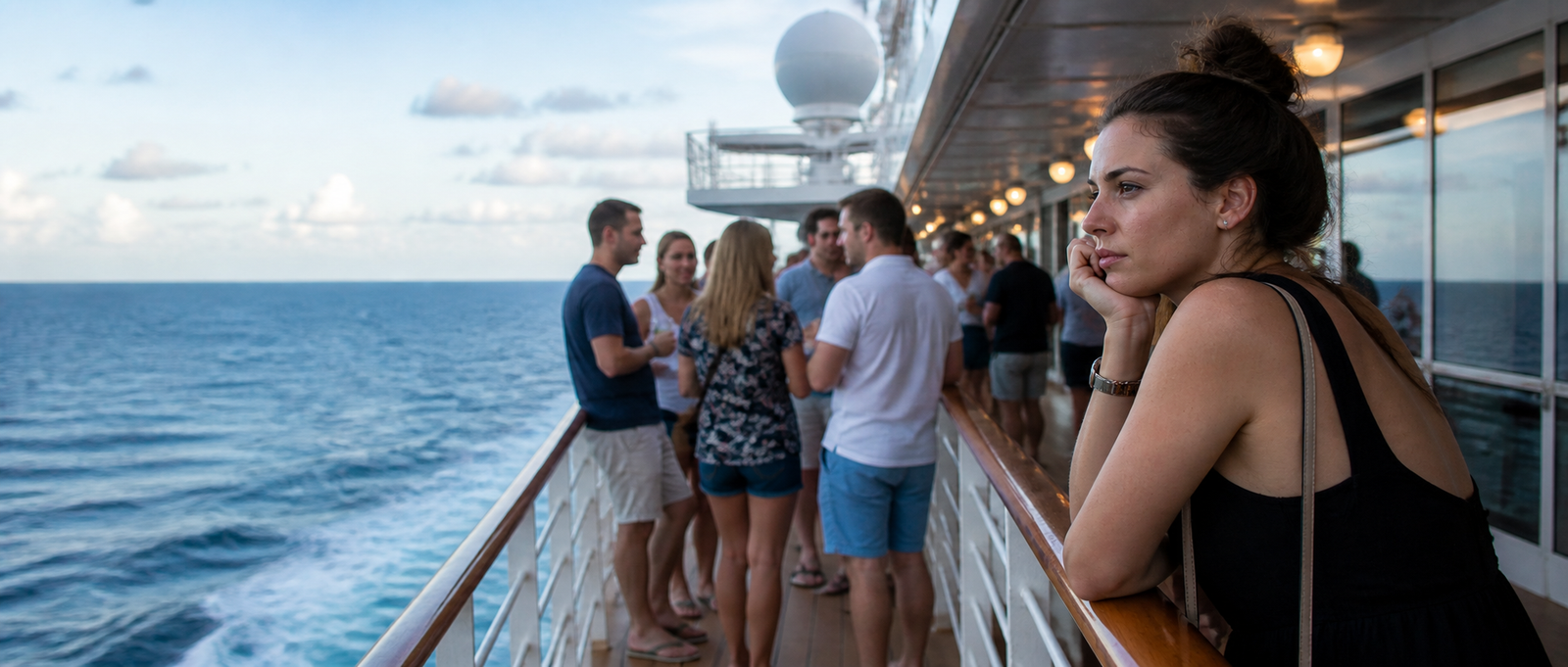
There is also an emotional layer to cruise social anxiety that rarely gets discussed. Vacations carry an unspoken obligation: you’re supposed to be having the time of your life. When you see groups laughing at the pool bar and feel like you’re the only person standing alone, that gap between expectation and experience feels amplified in a way that ordinary daily life never quite produces.
This performance pressure makes overthinking almost inevitable, raising questions about whether asking to join a shuffleboard game might feel like an imposition, while hesitation at the bar comes from uncertainty about whether a stranger wants to chat or simply enjoy their drink, and the fear of an awkward conversation that doesn’t quickly become meaningful keeps anything from starting at all.
The honest truth is that most people on the ship are feeling some version of exactly the same thing. The majority of passengers are genuinely open to a conversation — they’re just waiting for someone else to take the lead. The small talk about the last port, the towel animal in your room. The suspiciously long queue at the gelato station — these micro-interactions are how friendships on a ship actually start. They are not trivial. They are the foundation.
For Solo Cruisers: The Challenge Is Even More Specific
Solo travellers feel all of the above more acutely, plus a challenge that is entirely their own. Many people who cruise alone have already spent time thinking about how to find a cruise partner — someone to share a shore excursion with, split costs on a private tour. Also, simply sit with at dinner without the low-grade self-consciousness of an empty chair across the table.
The fear of being visibly alone in a social environment that prizes togetherness is real enough to stop some solo travelers from booking at all. Even those who do board often spend the first two or three days in a kind of low-level social drift, hoping that the right connection will materialise before the ship reaches the first port.
What changes the outcome for solo cruisers isn’t confidence, exactly. It’s preparation. The travelers who walk onto a ship already knowing that someone in cabin 8042 is also a solo traveller who loves hiking and bad reality TV — those travelers have a completely different experience from day one.
What Actually Works: Intentional Connection Over Wishful Thinking
The cruisers who consistently find it easy to make friends on a cruise ship share a few habits. They show up at small-group activities rather than large passive shows — a cooking demonstration, a wine tasting, a fitness class — because these spaces are built for talking. They say yes to the ship’s organized social events. Especially on embarkation night when everyone is still finding their footing and the social slate is genuinely blank. And they introduce themselves before they feel fully ready, because the perfect moment has a habit of never arriving.
Technology has also started to close the gap that ship architecture created. The rise of cruise-specific communities and apps means that savvy travellers can now identify like-minded passengers before they even step foot on the gangway. Instead of wandering the lido deck hoping to find someone with a shared hobby. You can arrive with a shortlist of people you already know something about.
This is exactly the problem that Seaya was built to solve. The Seaya app connects cruisers who are sailing on the same ship, letting you find people who share your interests. your energy levels. Your idea of a good time — before you’ve even packed your suitcase. Whether you’re a solo traveler hoping to find a shore excursion companion, someone cruising with family who still wants adult conversation over cocktails, or a group looking to expand their social circle, the app removes the cold-approach anxiety entirely. You’re not walking up to a stranger. You’re following up on a conversation you already started.
The pre-voyage connection matters most when you’re trying to figure out how to find a cruise partner for practical reasons too — splitting the cost of a private excursion. Finding a cabin mate to avoid the single supplement, or simply coordinating who to look for at the sail-away party. Sorting that through seaya in the weeks before you board means you spend the trip living it, rather than logistics-ing your way through it.
The Mindset Shift That Changes Everything
Beyond tools and tactics, the most important thing you can bring onto a cruise is a reframed expectation. Most people board assuming connection will happen organically. When it doesn’t materialise within the first twenty-four hours, they quietly conclude they’re on the wrong ship. That cruising just isn’t social, or that something is wrong with them.
None of those things are true. What’s actually happening is that connection on a cruise — like most meaningful things in life — responds to a small amount of intention. Not performance. Not pressure. Just the decision to position yourself where conversation is possible. To lower the stakes of a first exchange, and to use the time before you board to make the cold approach a thing of the past.
The conditions on a cruise ship are genuinely ideal once you clear that initial barrier. Everyone is relaxed. Nobody has to be anywhere. You share a floating world for seven days, which creates an intimacy that daily life almost never offers. The people who learn how to meet people on a cruise often describe it as some of the easiest socializing they’ve ever done — once they got past the first five minutes.
Your next voyage doesn’t have to be the one where you spend the sea days alone. It just takes knowing where the friction comes from — and deciding, before you board, that you’re not going to let it run the week.

For Christian, Seaya is the culmination of a career-long obsession with innovation. By leveraging his deep technical expertise to dismantle legacy constraints, Christian is transforming the way travelers connect at sea. He is dedicated to keeping Seaya at the vanguard of the “what’s next,” proving that the most powerful innovations happen when world-class tech meets a completely new frontier.
SUBSCRIBE NOW
Your Next Cruise Adventure Awaits
- News & articles
Related Blog