Most articles about cruise meetup apps share one problem. They promise an honest comparison. Then they spend six sections explaining why one specific platform is the answer. The reader figures this out by paragraph three. By paragraph five, they have already closed the tab.
This one works differently. Three platform types dominate the pre-cruise social landscape right now. Facebook groups, dedicated cruise forums, and purpose-built cruise apps each serve a real purpose. They also each have genuine limitations. Understanding what each tool does well — and where each one stops working — produces a more useful conclusion than simply declaring a winner.
The context matters. Pre-cruise social planning is no longer a niche behaviour. According to CLIA’s 2024 State of the Cruise Industry report, solo travel bookings have grown for five consecutive years. The desire to meet people on a cruise before the ship leaves port is now a mainstream traveller concern. The platforms built to serve that need are not equally suited to it. Here is why.
Why the Platform You Choose Changes the Outcome
The social window on any cruise is shorter than most travelers expect. Groups form in the first 48 hours. Dining companions are established. The trivia team has its roster. The pool deck is claimed. The traveler who boards without existing connections enters a social landscape already taking shape without them.
This is not a quirk of cruise culture. It reflects something documented in social research. A study from the Journal of Travel Research found that solo travellers in structured group travel environments report significantly higher connection rates than those on unstructured holidays. The cruise ship manufactures social opportunity. But only for the traveller already positioned to receive it.
Pre-cruise connection is the positioning work. The traveller who arrives knowing two or three names is already inside that 48-hour window. The traveller who boards cold is outside it, trying to break in. The University of Kansas friendship study found it takes roughly 50 hours of shared time to build genuine friendship. A seven-night cruise gives you those 50 hours. The platform you use before boarding determines whether they start from zero or from a running position.
What this means practically: Every day spent not connecting before a cruise is a day of that 50-hour window lost. The platform that makes pre-connection easiest and most compatible is not a convenience. It is a material advantage over every traveler who boards cold.
Platform One — Facebook Groups: Community Strength, Compatibility Weakness
Facebook groups are where most pre-cruise social planning still lives. Dismissing them would be both inaccurate and unhelpful. For specific purposes, they are the best tool available. Understanding those purposes tells you where the platform stops working.
The genuine strength of Facebook groups is scale and speed. A popular sailing attracts hundreds of group members. That critical mass makes large-format social events possible. Slot pulls, cabin crawls, and sail-away gatherings need thirty or forty participants to work. Facebook is typically the only place that headcount assembles before embarkation. The collective intelligence is also valuable. Experienced cruisers share ship-specific advice — cabin quirks, port shuttle timing, dining package assessments — that no official source provides. For first-time passengers on a new ship, that community knowledge measurably improves trip planning.
The problem is structural. Facebook was built to host conversations among people who already know each other. Using it as a cruise partner finder requires adapting a general tool to a specific purpose. That adaptation always costs something. Pew Research’s 2023 study on digital social communities found that trust and privacy concerns are significantly higher in large general social media groups than in purpose-specific communities. A group of 400 passengers is also 400 people’s opinions about gratuity policy, 400 notifications about dress codes, and the occasional extended argument about nothing. Important posts from people genuinely trying to find cruise friends disappear beneath the volume within hours. The solo traveler searching for a cruise buddy with compatible interests cannot filter for them. They can only post publicly and hope the right person sees it.
Platform Two — Cruise Critic Forums: The Gold Standard for Ship Intelligence
Cruise Critic’s roll call forums have been hosting sailing-specific communities since the early internet era. They remain one of the most reliable pre-cruise resources available — not primarily as a social platform, but as an archive of ship-specific intelligence accumulated over decades.
The people in a Cruise Critic roll call are disproportionately experienced.Having sailed the ship before, they know which deck produces the least vibration. They also remember when the port shuttle actually runs versus when it is supposed to. Their institutional knowledge is genuine and often irreplaceable. For any traveler making real decisions about cabin selection, dining strategy, or port logistics, roll call forums are worth the effort of navigating them.
Roll calls also coordinate practical logistics effectively. Shared private excursions — which NerdWallet’s cruise planning guide documents as 30 to 60 percent cheaper than ship-sponsored tours — are routinely organised through roll call threads. The traveler who wants to find a cruise mate for a private port tour is more likely to find willing companions in a roll call than anywhere else. The community self-selects for planful, engaged travelers. That overlap is genuinely useful.
The limitation is the format itself. For travelers comfortable with long-form text threads and nested replies, forums work well. For anyone accustomed to mobile-first, real-time social platforms, they feel like using a library catalogue when you need a search engine. Profile information is limited and unverified. There is no tool for saying “I am a solo cruiser who wants a dinner companion who also prefers quiet mornings” and surfacing compatible people. You post publicly and search manually. It is slow, and the results are imprecise.
Platform Three — Dedicated Cruise Apps: Compatibility Matching at Scale
The case for a purpose-built cruise friend finder app is not that forums and Facebook groups fail. It is that they solve different problems. Once that is clear, which platform to use at which stage of planning becomes straightforward.
The problem a dedicated cruise app is designed to solve is compatibility matching. A traveler wanting to find cruise carnival friends who share their interest in slow-paced cultural excursions, prefer early mornings, and are also traveling solo cannot extract that information from a Facebook group without doing significant manual work. A platform built around interest profiles and sailing-specific closed communities surfaces that information directly. The first message sent to a potential cruise companion is addressed to someone who is already, in the most relevant ways, a probable match.
The privacy architecture is also different by design. A well-built cruise app gives users control over what they share and with whom. That matters particularly for solo travellers. Research published in Personal Relationships journal found that the quality of early social exchanges is a stronger predictor of friendship development than frequency of contact. Targeted, interest-based matching produces higher-quality first exchanges than public group posting. The signal-to-noise ratio is simply better. Less scrolling. More actual connection.
The cold-start problem is also structurally removed. Walking into a Facebook group of 300 people and initiating a genuine connection requires social confidence and persistence. A platform that reduces the introduction to a profile match and a direct message eliminates the most friction-heavy part of the process. The conversation begins on shared ground rather than having to find it.
Where Seaya Fits Into This Landscape
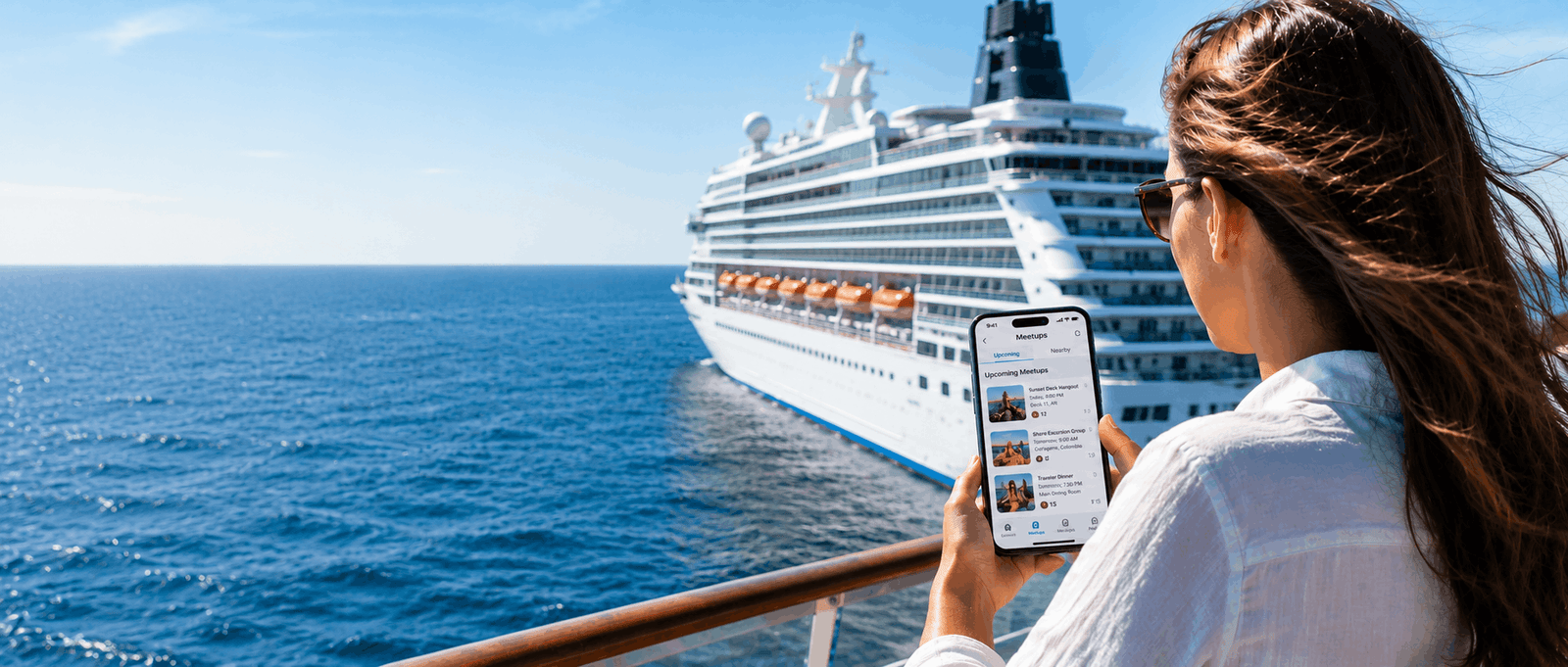
Seaya approaches the cruise connection problem from a specific angle. Rather than replicating the community breadth of a forum or the social energy of a Facebook group, it focuses on compatibility matching within sailing-specific closed communities. Travelers enter their cruise line, ship, and departure date. They access a community defined entirely by that sailing. Interest-based filters then narrow toward people whose travel style actually aligns with theirs.
For solo travelers, this architecture removes the most consistent frustration with other platforms: the effort-to-result ratio. Finding people on cruise ship sailings who are genuinely compatible — not just present — requires either significant effort on general platforms or a tool designed for the purpose. Seaya allows users to identify compatible cruise buddies without the public visibility of a forum post or the noise of a large group chat. The traveller using the platform as a cruise partner finder is operating with better information and lower friction than any equivalent search on Facebook or a forum.
The safety dimension is also worth noting. Seaya’s closed sailing communities and profile verification reduce the anonymity problem that makes large public groups less trustworthy. Travelers can build familiarity through direct messages before meeting in person. They arrive at the first onboard meeting knowing something genuine about the person they are meeting. That pre-established context makes the in-person transition considerably easier than a cold introduction at a sail-away party.
One practical note: experienced cruisers tend to use Seaya alongside other platforms rather than instead of them. The forum for ship intelligence. Facebook for large-scale events. Seaya for intentional one-to-one compatibility matching. Each tool doing the specific job it was built for.
Platform Comparison: What Each Tool Actually Does
The table below reflects an honest assessment of how these platforms perform for a traveler trying to meet people on cruise before departure. No platform is perfect. All three have a legitimate place in a well-planned pre-cruise strategy.
| Feature | Facebook Groups | Cruise Forums | Dedicated Cruise App |
| Cruise-specific matching | ✗ No | ✗ No | ✓ Yes |
| Interest filtering | ✗ No | ✗ No | ✓ Yes |
| Profile verification | Limited | Partial | ✓ Yes |
| Private sailing community | ✗ No | ✗ No | ✓ Yes |
| Real-time messaging | ✗ No | Partial | ✓ Yes |
| Excursion coordination | Comments | Comments | Built-in |
| Solo traveler tools | ✗ Minimal | Basic | ✓ Yes |
| Mobile-first design | ✗ No | Partial | ✓ Yes |
| Signal-to-noise ratio | Low | Medium | High |
The most important column is the last one. A dedicated cruise app does not replace forums or Facebook groups. It solves the specific problem neither was designed to address.
The Financial Case — Stated Simply
The economics of pre-cruise social planning are straightforward. They do not need investment metaphors or asset management analogies. The numbers speak clearly enough on their own.
Most cruise lines price cabins on double occupancy. The solo traveller pays a single supplement of 50 to 100 percent on the base fare. According to Skift’s 2024 travel pricing analysis, the single supplement remains one of the most cited financial barriers to solo travel growth. That premium is unavoidable. What is avoidable is paying full price for every experience on top of it.
Shore excursions are where the calculation becomes most concrete. Private independent tours typically cost 30 to 60 percent less per person than ship-sponsored options. Those tours are also better — smaller groups, more flexibility, deeper local access. But they require a minimum headcount. The solo traveler with no pre-existing connections defaults to ship pricing. The solo traveler who used a cruise friend finder app to find three compatible companions shares a private guide four ways. Across a seven-night sailing with four or five port days, that saving often exceeds the cost of the single supplement itself.
Pre-cruise social planning, approached as a practical strategy rather than a comfort measure, is one of the most reliable ways to improve the financial return on an expensive trip. The cruise app is not just a social tool. For the solo traveler paying the premium, it is a budgeting tool with real and measurable consequences.
The number that matters: NerdWallet documents 30–60% per-person savings on private vs. ship excursions. On a 7-night cruise with 4 port days, that differential frequently exceeds the single supplement cost. Finding a cruise partner before boarding is not just social planning. It is financial planning.
How to Use These Platforms Together — A Practical Sequence
The most effective pre-cruise social strategy is not a choice between platforms. It is a sequence that uses each tool for what it does best, at the right stage of planning.
Start with the roll call or Facebook group six to eight weeks before sailing. The goal at this stage is not finding your cruise friends. It is absorbing the ship-specific knowledge that experienced cruisers share freely. What is the best deck for embarkation morning? Which dining option suits a solo traveler? What are other people saying about the specific ports on this itinerary? Participate enough to establish a minimal presence. Read more than you post.
Around four weeks out, shift to intentional connection. This is when a purpose-built cruise app earns its place. Your sailing is concrete and close enough that plans will actually be kept. Use the interest filters to find fellow travelers whose profile matches what you are actually looking for. Not just someone on the same ship. Someone whose travel style makes them a realistic cruise companion for the week. A 2023 study in Nature Human Behaviour found that people consistently underestimate how much they enjoy interactions with people they have pre-connected with. The apprehension before the first message is almost always disproportionate to the experience of sending it.
When writing that first message, be specific. A question about a shared port interest works better than a generic introduction. Research from Oxford on communal experience shows shared activities accelerate social bonding faster than most people expect. One genuine message about a specific shared interest does more relational work than ten enthusiastic one-liners. Quality over frequency, from the very first exchange.
Safety Without Overclaiming It
Any guide to meeting people through digital platforms before a trip should address safety. It should also avoid making it the dominant note of the piece. Doing so misrepresents the actual risk profile of cruise social communities.
Cruise social platforms self-select for a specific kind of user. Someone who has made a significant financial commitment to a specific sailing. That shared commitment creates a transparency and accountability general social media platforms lack. Pew Research’s community trust analysis found that purpose-specific online communities with defined membership criteria consistently show higher trust ratings than general social networks. The cruise context is one of the clearest examples of this pattern.
The practical guidance is brief and consistent across all credible sources. Keep cabin numbers private until genuine trust is established. Arrange first in-person meetings in high-traffic public areas of the ship. Let the relationship develop at a pace proportionate to actual familiarity. The atrium on embarkation evening is a near-perfect first meeting location. Celebratory atmosphere. Highly visible. Naturally brief. If the in-person chemistry differs from the digital exchange, the ship is large enough that no one needs to feel awkward about it.
The Honest Conclusion
The best platform for meeting people on a cruise before you board is not a single answer. It is a sequence.
Use Facebook groups for community energy and large-scale onboard events. They are irreplaceable for the critical-mass coordination that makes slot pulls and sail-away gatherings work. Use Cruise roll calls for ship intelligence. The institutional knowledge accumulated in those forums is genuine and not easily replicated elsewhere. Use a dedicated cruise app — one built around sailing-specific communities and interest-based matching — for the specific work of finding people who are likely to become genuine cruise friends rather than just fellow passengers you have been near.
The financial case for making this effort is real. The solo traveler who boards with connections pays less for excursions, splits private tours, and extracts more value from the single supplement they already paid. The social case is equally real. The 48-hour social window at the start of any sailing is not a metaphor. It is the period during which the fabric of a cruise trip is actually woven. Being inside it, rather than trying to break in from outside, changes everything about the week that follows.
Seaya represent the more intentional end of this spectrum. Built around compatibility matching rather than general community chat, they address the specific gap that forums and Facebook groups were never designed to close. They are one part of a three-part strategy. Used in the right sequence, at the right time, they transform the social experience of a cruise from something that happens to you into something you helped build before the gangway opened.
The ship boards the same passengers regardless of which platforms they used beforehand. What changes is what happens once they are on it.

For Christian, Seaya is the culmination of a career-long obsession with innovation. By leveraging his deep technical expertise to dismantle legacy constraints, Christian is transforming the way travelers connect at sea. He is dedicated to keeping Seaya at the vanguard of the “what’s next,” proving that the most powerful innovations happen when world-class tech meets a completely new frontier.
SUBSCRIBE NOW
Your Next Cruise Adventure Awaits
- News & articles
Related Blog