Key Takeaways
- Choosing the right cruise starts with understanding your own travel style, not browsing destinations first.
- Ocean cruises suit travelers who want variety, entertainment, and resort-style amenities; river cruises suit those chasing culture and a slower, more intimate pace.
- Cruise length should match your available time and your tolerance for sea days versus port days.
- Destination choice should be filtered by climate preference, flight tolerance, and whether you want beaches, culture, or nature.
- Cruise lines fall into clear categories — mainstream, premium, luxury, adults-only, expedition — and matching the category matters more than chasing brand names.
- Budget and luxury cruises offer different value structures, not simply “less” versus “more.”
- Cabin choice should reflect how much time you’ll actually spend in the room, not just what looks nicest in photos.
- Hidden costs — gratuities, drink packages, Wi-Fi, excursions — can significantly change your total trip cost.
- Travel insurance and a realistic full-trip budget prevent most common cruise-planning regrets.
- The people you meet and connect with before and during the cruise can shape the experience as much as the itinerary itself.
Choosing a cruise isn’t really about finding “the best” cruise. It’s about finding the cruise that fits how you actually like to travel. A ship packed with waterslides and Broadway-style shows might be a dream for a family of five and a nightmare for a couple chasing quiet sunsets. A 14-day transatlantic crossing might be pure bliss for a retired reader and pure boredom for someone who wants a new port every morning.
Why Choosing the Right Cruise Matters
A lot of first-time cruisers assume that a cruise is a cruise — you get on a big boat, you eat a lot, you see some ports, you come home relaxed. That assumption causes more disappointing vacations than almost anything else in travel planning.
The truth is that two cruises can share the word “cruise” and have almost nothing else in common. A mega-ship carrying 6,000 passengers through the Caribbean with a water park, a go-kart track, and a nightly DJ set is a fundamentally different experience from a 200-passenger expedition vessel navigating fjords in Norway with a marine biologist giving lectures over coffee. Neither is better. They’re built for different people.
Every traveler brings different expectations onto a ship: some want constant stimulation, others want silence and a good book. Some want to see six countries in ten days, others want to sit still in one region and actually absorb it. When your cruise choice matches your travel style, everything downstream gets easier — the itinerary makes sense, the pace feels right, the onboard crowd feels like “your people,” and the money you spent feels justified.
When the match is wrong, even a well-run, highly-rated cruise can feel off. You might come home saying “it was fine” instead of “I want to do that again.” Choosing wisely up front is what separates those two outcomes, and it’s a decision worth spending real time on before you swipe a credit card.
Understand Your Travel Style First
Before comparing itineraries or cruise lines, it helps to get honest about how you actually like to spend a vacation. Most travelers fall into a few recognizable patterns, and knowing yours narrows the entire decision tree fast.
Relaxation seekers want unstructured time. Their ideal day involves a lounge chair, a book, room service, and maybe one massage. For this style, ship size matters less than onboard atmosphere — a quieter, adults-leaning ship with fewer forced activities usually wins.
Adventure travelers want to be outside, moving, and doing something they’ve never done before — hiking a glacier, snorkeling a reef, kayaking near icebergs. Expedition and small-ship cruising tend to serve this style best, since itineraries are built around access to remote or active experiences rather than resort-style comfort.
Families need flexibility, kids’ programming, and cabins that don’t feel cramped with four people in them. Larger mainstream ships tend to shine here because they’re designed around supervised kids’ clubs, family pools, and entertainment that works for a wide age range.
Couples often want a mix of romance and activity — private balconies, adults-only areas, specialty dining, and evenings that don’t revolve around a kids’ talent show. Mid-size premium ships or adults-only sailings tend to fit well.
Solo travelers are looking for community without pressure. Ships with dedicated solo cabins, solo traveler meetups, and communal lounge spaces make a noticeable difference in how connected a solo cruiser feels by day three.
Most people are a blend of two or three of these — a couple who wants both romance and adventure, or a family that wants kids’ programming but also a quiet adults-only pool deck. That’s normal. The goal isn’t to pick one label; it’s to rank what matters most so you can filter out ships and itineraries that clearly don’t fit.
Ocean Cruise vs River Cruise
This is one of the first forks in the road, and it changes almost everything about the trip.
Ocean cruises sail across seas and oceans, calling at coastal cities and islands. Ships range from mid-size to enormous, with pools, multiple dining venues, entertainment theaters, and sometimes water parks or rock climbing walls. Days at sea are common, giving you full days to enjoy the ship itself.
River cruises sail along inland waterways — the Danube, Rhine, Mekong, Nile, or Mississippi, for example. Ships are much smaller, usually carrying 100–200 guests, and they dock directly in the heart of cities and towns, often within walking distance of major landmarks. There’s rarely a “day at sea” on a river cruise; you’re moving through a region and stepping off almost daily.
| Feature | Ocean Cruise | River Cruise |
|---|---|---|
| Ship size | Large to massive (1,000–6,000+ guests) | Small (100–200 guests) |
| Destinations | Coastal cities, islands, open sea | Inland cities, countryside, historic towns |
| Atmosphere | Energetic, resort-like | Intimate, slower-paced |
| Onboard activities | Pools, theaters, casinos, water parks | Lectures, small lounges, sun deck |
| Port access | Tender or dock, often outside city center | Dock directly in town, walkable |
| Typical daily pace | Mix of sea days and port days | Port almost every day |
| Best for | Families, entertainment seekers, first-timers | Couples, culture lovers, slower travelers |
| Budget | Wide range, often lower per day | Typically higher per day, more inclusive |
If you want big-ship energy, variety, and entertainment, ocean cruising is the natural fit. If you want deep cultural immersion, walkable ports, and a quieter, more intimate ship, river cruising usually feels more rewarding — especially for travelers who’ve already done a big ocean cruise and want something different next.
Choosing the Right Cruise Length
Cruise length shapes the entire trip, not just how many nights you’re away.
Weekend cruises (2–4 nights) are short, often sailing to one or two nearby ports or simply spending a couple of days at sea. They’re ideal for first-timers testing whether they enjoy cruising, or for travelers squeezing a getaway into a long weekend. Don’t expect a deep itinerary — think of it as a preview.
Classic cruises (5–7 nights) are the sweet spot for most travelers. A week gives you enough time to visit several ports, enjoy a couple of sea days, and settle into ship life without using up your entire vacation allowance. Most Caribbean, Mediterranean, and Mexican Riviera itineraries fall into this window.
Long voyages (10–21 nights) suit travelers who want to go deeper into a region — the full Mediterranean coastline, a complete loop of Northern Europe, or a slow crossing of the Atlantic. These trips reward people who don’t mind a slower pace and want fewer, longer stops rather than a new port every single day.
World cruises (2–4+ months) are a different category altogether, usually built for retirees or travelers with the flexibility to be away for an extended stretch. These circle the globe with dozens of ports and long stretches at sea, and they come with a price tag to match.
A simple rule that helps most travelers: match cruise length to how much time you actually have and how much port-hopping you enjoy. A short cruise with a packed itinerary can feel rushed. A long cruise with too few ports can feel slow if you’re someone who needs constant new scenery. Be honest about your own attention span for “days at sea” before booking anything longer than a week.
How to Choose the Right Cruise Destination
Destination choice usually comes down to what kind of experience you’re chasing — beaches and nightlife, glaciers and wildlife, ancient history, or something in between.
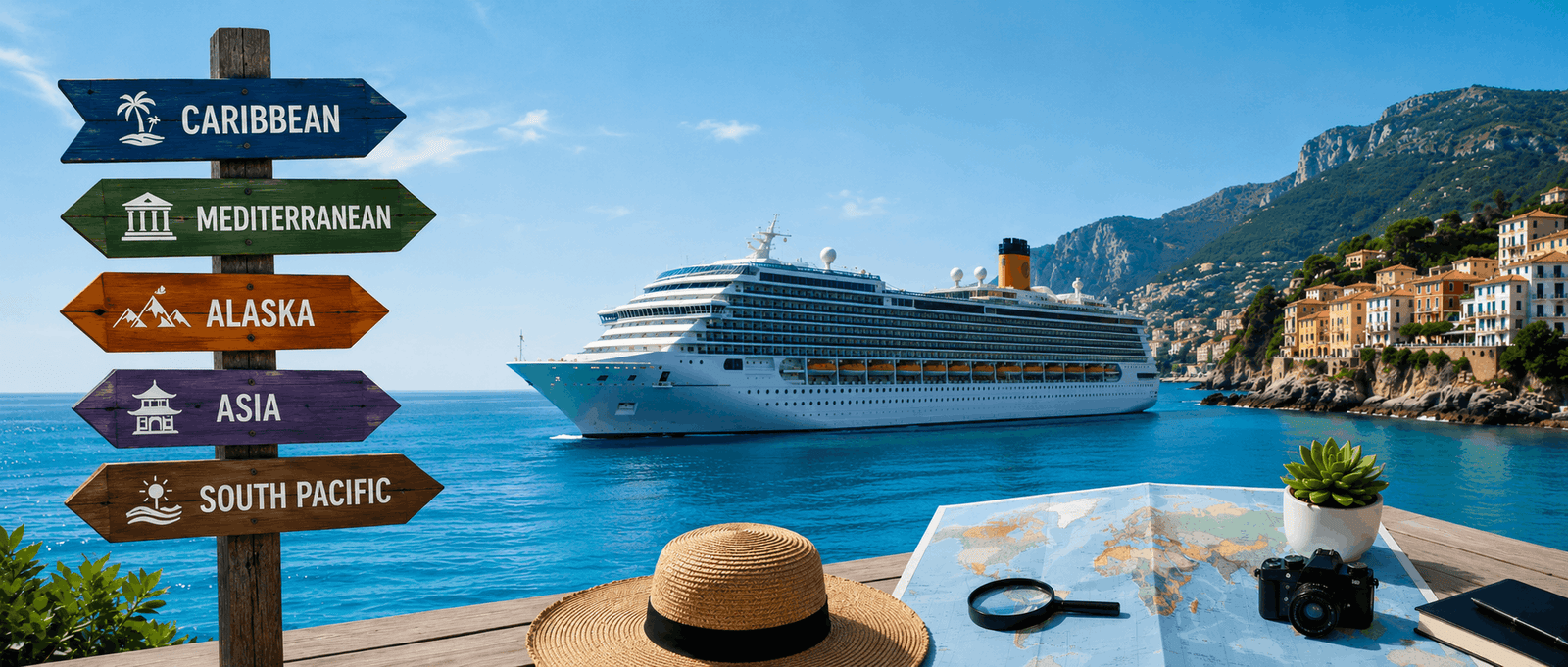
The Caribbean is the most popular cruise region in the world for good reason: warm weather nearly year-round, short flights from much of North America, beach-focused ports, and itineraries that suit first-timers, families, and couples alike. It’s a strong choice if you want sun, easy logistics, and a relaxed pace.
The Mediterranean blends history, food, and coastal beauty — Barcelona, Rome, Santorini, Dubrovnik. It suits travelers who want culture and sightseeing layered into their sea days, and it works well for couples and multigenerational groups who want variety in a single trip.
Alaska draws travelers chasing glaciers, wildlife, and dramatic scenery rather than beach time. It’s a strong fit for adventure travelers, nature lovers, and anyone who wants a cooler-weather cruise with genuinely different scenery from a typical Caribbean run.
Northern Europe (the Baltic, Norwegian fjords, British Isles) appeals to history-focused travelers and those who’ve already done the Caribbean and Mediterranean and want something quieter and more scenic, with fewer crowds and longer daylight hours in summer.
Asia itineraries — Japan, Southeast Asia, Vietnam’s Halong Bay — suit travelers who want a deep cultural experience and are comfortable with longer flights to get to the embarkation port. These trips reward curiosity and a willingness to try unfamiliar food and customs.
Australia and the South Pacific combine beach time with a genuinely remote, less-crowded feel. These routes suit cruise travel who have more flexible timelines, since flights are long, and who want island-hopping without the crowds common in the Caribbean.
If you’re choosing your first destination, think about climate preference, flight length you’re willing to tolerate, and whether you want the trip centered on relaxation, culture, or nature. That single filter eliminates most of the noise.
Choosing the Right Cruise Line
Cruise lines generally fall into a handful of categories, and understanding the category tells you more than any single review will.
Family-friendly / mainstream lines run large ships with broad entertainment, kids’ clubs, and a wide range of cabin categories at accessible prices. They’re built to appeal to the widest possible audience, which makes them a safe first choice for families and first-time cruisers.
Premium lines sit a step above mainstream — smaller ships, more inclusive dining, generally older or more experience-focused clientele, and a quieter onboard atmosphere. They suit couples and travelers who want more polish without going fully luxury.
Luxury lines offer all-inclusive or near-all-inclusive fares, small ship sizes, high staff-to-guest ratios, and elevated service throughout. They suit travelers prioritizing comfort, space, and personalized service over price.
Adults-only lines remove children from the equation entirely, creating a calmer, more romantic or social atmosphere depending on the brand. They suit couples and groups of friends who specifically want to avoid family-heavy sailings.
Expedition lines focus on remote, nature-driven destinations — Antarctica, the Galápagos, the Arctic — with small ships, onboard naturalists, and itineraries built around wildlife and landscape rather than entertainment. They suit adventure travelers and anyone who wants a destination-first, ship-second experience.
There’s no single “best” cruise line — only the one that matches the category you actually want. A traveler who books a family-oriented mega-ship expecting a quiet, romantic trip will likely be disappointed, not because the ship is bad, but because it was never designed for that experience in the first place.
Budget vs Luxury Cruises
Price differences between cruise categories aren’t arbitrary — they reflect real differences in what’s included and how the experience feels day to day.
| Feature | Budget Cruise | Luxury Cruise |
|---|---|---|
| Fare inclusions | Cabin, basic dining, entertainment | Often all-inclusive: drinks, gratuities, excursions |
| Ship size | Large, high guest count | Small to mid-size, low guest count |
| Dining | Main dining room + casual venues | Multiple included specialty restaurants |
| Service ratio | Standard staff-to-guest ratio | High staff-to-guest ratio |
| Cabin space | Compact standard cabins | Larger suites, more balcony space |
| Atmosphere | Lively, high-energy | Quiet, refined, personalized |
| Extra costs | Drinks, specialty dining, Wi-Fi, excursions typically extra | Fewer add-ons, more predictable total cost |
| Best for | Budget-conscious travelers, families, first-timers | Travelers prioritizing comfort and service |
Budget cruising isn’t a lesser experience — it’s simply a different value proposition. You pay less upfront and choose what to add (specialty dining, drink packages, excursions), which gives you control over spending. Luxury cruising bundles most of that into the fare, so the sticker price is higher but the final bill is often more predictable and closer to what you actually paid.
The right choice depends on how you like to budget. If you enjoy customizing every part of a trip and don’t mind paying a la carte, budget and mainstream cruising can offer excellent value. If you’d rather pay once and stop thinking about the bill, luxury cruising removes that friction entirely.
Choosing the Right Cabin
Cabin type affects your trip more than most first-time cruisers expect, since it’s where you’ll start and end every day.
Inside cabins have no window at all. They’re the most affordable option and work well for travelers who plan to spend most of their time exploring the ship and ports rather than relaxing in the cabin — think budget-conscious solo travelers or families needing extra rooms for kids.
Ocean view cabins add a window or porthole with a sea view but no access to fresh air. They suit travelers who want natural light and a view without paying balcony prices, particularly on itineraries with cooler weather where a balcony sees less use anyway.
Balcony cabins add a private outdoor space, letting you enjoy morning coffee or evening drinks with a private ocean view. They’re a strong middle-ground choice for couples and travelers on warm-weather itineraries where outdoor time matters.
Suites offer significantly more space, often with separate living areas, upgraded amenities, and sometimes priority boarding, dedicated dining, or concierge service. They suit travelers wanting extra comfort, multigenerational families needing more room, or special-occasion trips.
A practical way to decide: think about how much time you’ll actually spend in the cabin versus out exploring, and match your spend accordingly. Paying for a suite on a cruise where you’ll barely be in the room is often money better spent on excursions or specialty dining instead.
Activities That Match Your Travel Style
Once the ship and itinerary are chosen, activities are what actually fill your days — and they should match the sustainable travel style you identified earlier.
Relaxation-focused travelers should look for ships with quiet adults-only decks, spa access, and minimal forced programming. Adventure travelers should prioritize itineraries with strong shore excursion programs — hiking, snorkeling, diving, or wildlife viewing — since the best adventure happens off the ship, not on it.
Dining-focused travelers should check how many specialty restaurants are available and whether food-focused shore excursions (market tours, cooking classes, wine tastings) are offered in port. Wellness-focused travelers should look at spa size, fitness class offerings, and whether the ship has dedicated wellness programming rather than a single small gym.
Nightlife seekers should check entertainment lineups, casino size, and late-night venue options — this varies enormously between ships even within the same cruise line. Families should confirm the age range and structure of kids’ clubs, since some ships group children broadly while others separate by age with dedicated staff and activities for each group.
Shore excursions deserve their own attention regardless of travel style. They’re often the highlight of a cruise, and booking through the ship isn’t always necessary — many independent local operators offer the same experiences at a lower price, though the ship-run tours come with the safety net of guaranteed return timing before departure.
Common Mistakes Travelers Make When Choosing a Cruise
Even experienced travelers fall into a few predictable traps when booking a cruise.
Choosing based only on price. The cheapest fare often hides costs that show up later — gratuities, drink packages, Wi-Fi, and excursions can add hundreds of dollars per person. Compare total likely cost, not just the headline fare.
Ignoring the itinerary. A great ship with a mediocre itinerary is still a mediocre trip. Look closely at how much time is spent in port versus at sea, and whether the ports actually interest you, before falling in love with a ship’s amenities.
Booking the wrong cabin category. Choosing an inside cabin for a long, warm-weather itinerary — or a pricey suite for a short trip you’ll barely spend time in — are both common regrets. Match cabin type to how the trip will actually be used.
Not researching the cruise line. Assuming all cruise lines are interchangeable leads to mismatched expectations. A traveler expecting quiet luxury on a high-energy family ship will be disappointed, and vice versa.
Forgetting hidden costs. Gratuities, specialty dining, shore excursions, Wi-Fi, and travel insurance can meaningfully change your total spend. Build a realistic full-trip budget before comparing fares across lines.
Booking too close to departure without checking availability trends. Popular itineraries and cabin categories sell out, and last-minute bookings sometimes mean settling for a worse cabin location or missing sold-out excursions.
Overlooking travel insurance. Cruises involve non-refundable deposits, multiple destinations, and higher stakes if something goes wrong. Skipping insurance to save money can backfire badly if plans change.
Questions to Ask Before Booking
Before finalizing any cruise, run through this checklist:
- What travel style am I optimizing for on this specific trip?
- Does the itinerary actually visit places I want to see, or just places that are convenient for the cruise line?
- Is this an ocean or river cruise, and does that match the pace I want?
- How many sea days versus port days does this itinerary include?
- What’s actually included in the fare, and what will likely cost extra?
- Does the cabin category match how much time I’ll spend in the room?
- What’s the average age and type of traveler this ship or line typically attracts?
- Are there adults-only spaces if I want to avoid family-heavy areas?
- What’s the cancellation and refund policy if my plans change?
- Do I have travel insurance that covers trip interruption, medical needs, and missed connections?
- Have I budgeted realistically for gratuities, excursions, and onboard extras?
Answering these honestly before booking prevents most of the regret that shows up in post-cruise reviews.
How Seaya Helps Travelers Choose the Right Cruise Experience
Choosing the right ship, cabin, and itinerary solves half the equation. The other half is who you actually spend the trip with — and for a lot of cruisers, that part is left entirely to chance.
This is where a platform like Seaya fits into the planning process. Instead of boarding a ship full of strangers and hoping you happen to meet people with similar interests, Seaya lets travelers connect with fellow passengers on the same sailing before they ever step on board. If you’re a solo traveler hoping to find a group for shore excursions, a couple looking for other couples to share a dinner table with, or a family hoping to connect with other families for pool time, that kind of matching usually happens by luck on a traditional cruise — if it happens at all.
Seaya also makes it easier to plan activities together ahead of time, so instead of figuring things out day-by-day once you’re already at sea, you can arrive with a rough plan and a few familiar faces already in place. For travelers who value learning from people who’ve cruised the same route or line before, connecting with experienced cruisers beforehand can also help set realistic expectations about pacing, excursions, and onboard life.
None of this replaces the core work of choosing the right ship and itinerary — that decision still comes first. But once you’ve picked a cruise that matches your travel style, a tool that helps you build community around that specific sailing can meaningfully change how the trip feels, particularly for solo travelers and anyone hoping the people around them will match their energy as well as the destination does.
Final Tips for Choosing the Perfect Cruise
Start with your travel style, not the destination. Once you know whether you’re chasing relaxation, adventure, romance, or family time, everything else — ship size, cruise line category, itinerary length — becomes much easier to filter.
Read itineraries line by line before comparing prices. Two cruises priced identically can have very different amounts of time in port, and that difference matters more than most travelers realize until they’re on board.
Don’t assume bigger is better, or that luxury automatically means “worth it.” Bigger ships offer more variety but less intimacy; luxury ships offer more service but less energy. Match the trade-off to what you actually want from the week.
Build your full budget before booking, including gratuities, at least one specialty cruise dinner, a couple of shore excursions, and travel insurance. That number is almost always higher than the advertised fare, and knowing it upfront prevents surprises.
Finally, don’t underestimate the social side of cruising. Who you spend your days with — new friends, fellow solo travelers, or a group with shared interests — often shapes how a trip is remembered just as much as the ports themselves.
FAQs
1. How do I choose the right cruise?
Start by identifying your travel style — relaxation, adventure, family time, romance, or a mix — and use that to filter ship size, cruise line category, and itinerary. From there, narrow down by destination, length, and budget, checking that the itinerary’s actual pace matches how you like to travel.
2. Which cruise is best for first-time travelers?
A 5–7 night mainstream cruise to the Caribbean or Mediterranean is generally the safest starting point. These itineraries balance sea days and port days well, sail on larger ships with broad entertainment options, and give first-timers a realistic sense of whether they enjoy cruising before committing to longer or more specialized trips.
3. How do I choose a cruise destination?
Think about climate preference, how long a flight you’re willing to take to reach the embarkation port, and whether you want a beach-focused, culture-focused, or nature-focused trip. The Caribbean suits beach and relaxation seekers, the Mediterranean suits culture lovers, Alaska suits nature and wildlife fans, and Northern Europe or Asia suit travelers wanting something less crowded or more immersive.
4. Should I choose a short or long cruise?
Choose a short cruise (2–7 nights) if it’s your first time cruising or you have limited vacation time. Choose a longer voyage (10+ nights) if you want to explore a region in depth and don’t mind a slower pace with more time at sea between ports.
5. What is the difference between ocean and river cruises?
Ocean cruises sail on large ships across seas and oceans, offering resort-style amenities and a mix of sea days and port stops. River cruises sail on small, intimate ships along inland waterways, docking directly in city centers almost daily, which suits travelers who prioritize culture and walkability over onboard entertainment.
6. Which cruise line is best for families
Mainstream, family-friendly cruise lines with large ships tend to work best for families, since they offer structured kids’ clubs, family-sized cabins, and entertainment designed to appeal across age groups. Look specifically at how each line structures its kids’ programming by age group before booking.

For Christian, Seaya is the culmination of a career-long obsession with innovation. By leveraging his deep technical expertise to dismantle legacy constraints, Christian is transforming the way travelers connect at sea. He is dedicated to keeping Seaya at the vanguard of the “what’s next,” proving that the most powerful innovations happen when world-class tech meets a completely new frontier.
SUBSCRIBE NOW
Your Next Cruise Adventure Awaits
- News & articles
Related Blog