There is a particular kind of loneliness that nobody warns you about when you book a cruise. It is not the loneliness of the open ocean. That part is actually beautiful.
It is the loneliness of standing in a buffet line with 4,000 strangers. You hold your tray and search the room for a familiar face, but find none. For first-time cruisers and seasoned sailors alike, that moment hits harder than expected.The cruise industry recognised this years ago. That is why the social side of cruising now matters as much as the itinerary for many travelers.
Some people cruise solo for the first time. Others want a cruise partner for shore excursions or hope to make friends before boarding. Most travelers ask the same question: where can you meet people before the cruise begins?
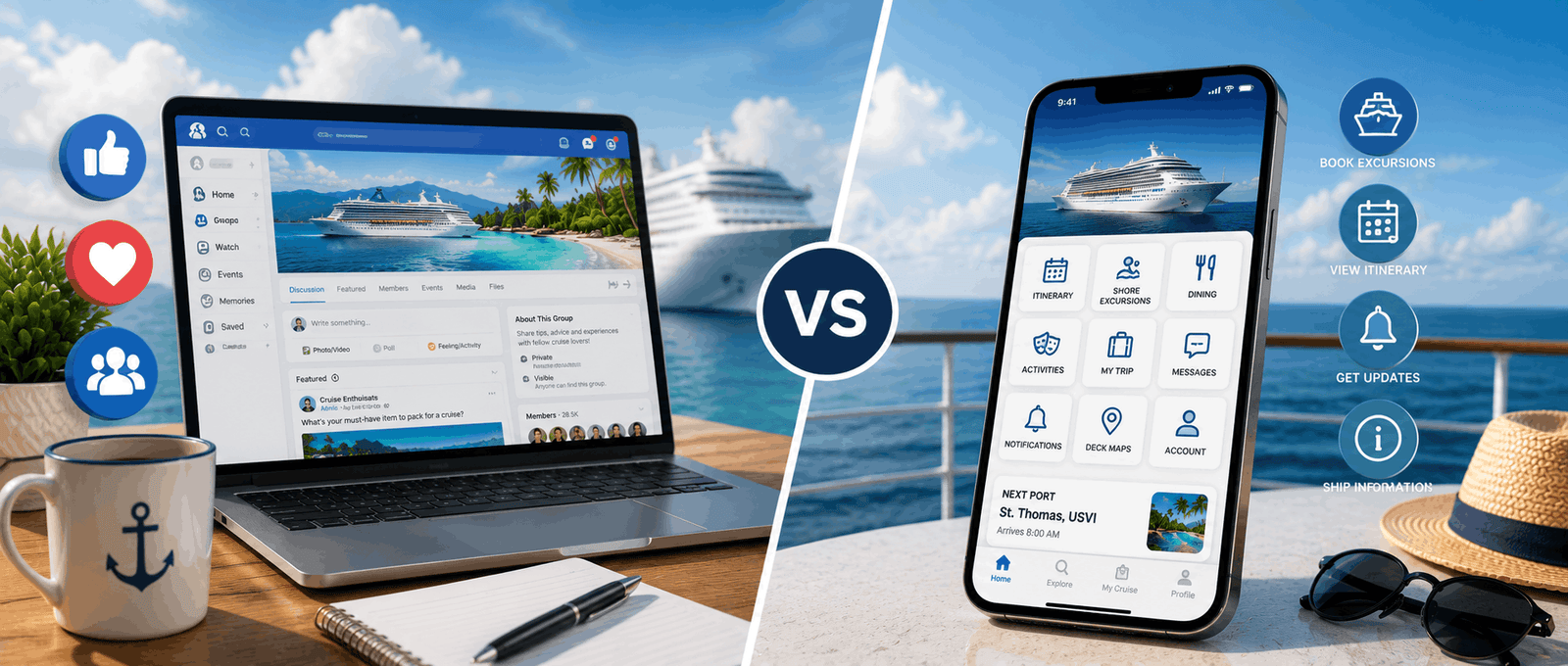
Two answers dominate that conversation right now. The first is Cruise Facebook Groups — the long-established community hubs that have been connecting cruisers for years. The second option is a newer generation of cruise connection apps. These apps help travelers meet people before and during the cruise. Both options offer real value. Both also have limitations. The differences between them can strongly shape the overall cruise experience.
This is the honest breakdown.
Why Cruise Connection Has Become Part of the Planning Process
A decade ago, cruise was primary sold as a destine experience. The ship was transport plus accommodation plus entertainment, and the people on it were incidental to the experience. That framing has shifted considerably, driven by a generational change in what travelers actually want from a holiday.
Younger cruisers, especially solo travelers, now see social connection as an important part of the cruise experience. According to CLIA’s 2024 State of the Cruise Industry report, solo cruise bookings have increased for five straight years. Cruise lines have responded by adding more single cabins, hosting solo traveler events, and redesigning shared spaces. Many travelers now want the freedom of solo travel without feeling alone during the trip.
That is why pre-cruise social planning has become so valuable. Cruisers who already know a few people often feel more confident during the first days of the trip. Research supports this idea. A study in the Journal of Personality. Social Psychology found that expected social connections can reduce anxiety in unfamiliar group settings.
On a ship full of strangers, that is not a trivial benefit.
The question is not whether to build those connections before boarding. Most experienced cruisers agree you should. The question is which platform does it better.
What Cruise Facebook Groups Actually Offer
Cruise Facebook Groups are the traditional answer to the cruise connection problem. the for a long time they were the only real answer. The format is simple: someone creates a group organised around a specific ship. sailing date, passengers join, and the conversation begins weeks or months before departure. On a popular itinerary, these groups can attract hundreds of members. this generate genuinely useful discussion about everything from cabin selection to shore excursion logistics.
The practical value is real. Experienced cruisers often share the kind of operational intelligence. that no travel brochure includes — which deck has the best view during a particular sail-in, whether the specialty dining package is worth it on this specific ship, where to find the unofficial early-morning coffee spot that avoids the main buffet queue. For first-time cruisers especially, that institutional knowledge from a Facebook group can meaningfully improve the trip.
The experience of cruising with friends you have met through a Facebook group can also be genuinely warm. When a group chemistry develops naturally over weeks of conversation, the first in-person meeting on embarkation day often feels more like a reunion than an introduction. That social momentum is one of the real advantages of starting early in a well-run Facebook group.
The problem is not what Facebook groups offer. The problem is what they cannot filter out.
Large groups move fast and messy. Important posts disappear beneath memes, repeated questions, promotional content, and tangential arguments about gratuity policy. The traveler who posted a thoughtful question about solo dining options on Monday will often find it buried by Wednesday, unanswered beneath forty posts about whether to book the drink package. For someone trying to genuinely connect with compatible fellow cruisers rather than consume general cruise content, that noise ratio becomes genuinely frustrating. Privacy is a persistent concern too. Facebook groups vary enormously in moderation quality. Some are tightly manage and feel genuine safe. Others are effectively public forums where personal travel information, cabin details. solo travel plans are visible to anyone who has joined.
A 2023 NortonLifeLock report on social media privacy faun that over 60 percent of social media users have concerns about how their personal informant is use within group settings — a concern that falls disproportionately on solo female travelers, who are often the most active participants in cruise roll call groups and the most expos to that risk.
There is also a major design limitation: Facebook was create for general social conversation, not specifically to help travellers find compatible cruise partner or meaningful cruise connection. Locating a specific kind of traveller on a specific sailing with compatible interests requires the kind of filtering that Facebook simply does not offer. You can ask publicly and hope the right person replies. You cannot search algorithmically for someone who also wants to do the small-group food tour in Lisbon and has a similar appetite for late nights.
What Dedicated Cruise Apps Do Differently
The generation of dedicated cruise connection apps emerged specifically to solve the problems that Facebook groups cannot. Where Facebook is a general social platform that cruise traveler have adapter to their purposes, a purpose-built cruise friend app is designed from the groun up around the single challenge of helping cruiser find compatible people on their sail.
The functional difference is significant. Instead of joining a group of hundreds and posting publicly, travelers create detailed profiles that include their sailing information, travel style, and specific interests. The app then surfaces compatible fellow cruisers — people on the same ship and dates who share similar preferences — rather than presenting everyone on the sailing as an undifferentiated crowd. For someone using an app for cruise connection with a specific goal in mind, that filtering changes the experience entirely.
The privacy architecture is also different by design. A well-built cruise companion app gives users granular control over what information they share and with whom, rather than defaulting to the semi-public visibility of a Facebook group. For solo travelers in particular, that distinction matters. There is a meaningful difference between voluntarily connecting with a vetted traveler through a secure platform and broadcasting your solo travel plans to an open group of strangers.
Seaya was built on exact this premise. Rather than replicating the chaos of a large social media group in a cruise context, it matches cruisers based on shared interests and sailing details, creating smaller, more intentional connections. A traveller who wants to find cruise partner match for a cooking class in Barcelona, a hiking excursion in Madeira, or simply a dinner companion on sea day can use the platform filters to surface the people most like to be interest — rather than posting to a group of five hundred and hoping someone respond. That specificity is what separates a genuine cruise mate finder from a general community chat.
The coordination tools built into dedicated apps also address a chronic frustration with Facebook groups. Organising a shared private excursion through a Facebook comment thread — tracking who is in, who has dropped out, what time the car is leaving, and whether to book the tour through the local operator or the ship — is a logistical exercise that feels approximately as enjoyable as it sounds. Purpose-built coordination tools simplify that process considerably, which is one reason why experienced cruisers who have tried both tend to use the app for the planning and dip into Facebook for the general conversation.
Facebook Groups vs. Dedicated Apps: A Direct Comparison
The difference between the two approaches becomes clearer when you put them side by side. This table reflects the functional reality that most experienced cruisers describe after using both:
| Feature | Facebook Groups | Dedicated Cruise App |
| Primary Purpose | Community & Advice | Matching & Connection |
| Privacy Control | Limited / Public | User-controlled |
| Finding Travelers | Manual search, hit-or-miss | Filtered by sailing & interest |
| Solo Cruiser Tools | Minimal | Built-in compatibility matching |
| Noise Level | High (memes, ads, off-topic) | Low (cruise-focused only) |
| Meetup Planning | Comment threads | Integrated coordination |
| Onboard Use | Rare | Designed for it |
The table tells a consistent story: Facebook groups and dedicated apps are solving adjacent but meaningfully different problems. Facebook excels at community and information; dedicated apps excel at intentional connection and coordination. The travelers who get the most out of both understand which tool to reach for at which stage of their planning.
The Solo Traveler Test: Where the Difference Shows Up Most Clearly
Nothing exposes the gap between Facebook groups and dedicated apps more clearly than the solo cruiser experience. Cruising solo is one of the most liberating travel formats available — full control of your itinerary, no compromises on how you spend your time, the particular satisfaction of navigating a new port city entirely on your own terms. It is also, in its unmanaged form, one of the loneliest ways to travel.
The first-night dinner is the canonical solo cruise anxiety moment. Ships are design around tables of four and six, which means that a solo traveller show up to the main dining room without a plan either dines alone or asks to be seat with stranger. Both options are fine. Neither is ideal. The traveller who spent three weeks in a Facebook group trying to find dinner companions but never quite managed to convert a thread into an actual plan knows exactly how that evening tends to go.
Compare that to the experience of a solo traveler who used a dedicated cruise connection platform before boarding. By embarkation day, there are already a handful of names, faces, and tentative plans. There is someone to wave to at the Sail Away party who is not just being politely friendly. There is a group chat that has already moved past the awkward introductions into actual logistics. The first night dinner is already handle.
According to research from the University of Kansas on adult friendship formation, moving from stranger to genuine friend requires roughly 50 hours of shared casual time. A seven-night cruise can accelerate friendship-building — but only when travelers spend their first few hours connecting with people instead of wondering who they can relate to onboard.The purpose of a dedicated app for cruise connection is to eliminate that cold start entirely.
There is also a financial dimension to this that travel sites rarely mention. Private shore excursions through independent local operators typically cost 30 to 60 percent less than the equivalent ship-sponsored tour, according to NerdWallet’s cruise planning guide. But those tours require a minimum headcount to work economically. A solo traveler who cannot find three or four willing companions ends up paying ship prices by default. The ability to identify compatible fellow cruisers before the sailing — not just willing ones, but people whose travel style and excursion interests genuinely align — has a real dollar value attached to it.
How to Actually Make Friends on a Cruise: The Practical Approach
The travelers who consistently report the best social experiences on cruises tend to use both channels in a specific sequence, rather than treating this as an either/or choice.
The Facebook group comes first, typically joined six to eight weeks before sailing. Its value at this stage is intelligence gathering — learning the ship’s quirks, finding out which dining venues people are excited about, getting a general sense of the group’s demographic and energy. It is also where the large-scale social events get organist : slot pulls, cabin crawls, theme night coordination, the informal sail-away gathering at a specific bar. These are genuinely fun, and they tend to happen on Facebook because that is where the critical mass lives.
The dedicated app — or a more focused social platform like Seaya — comes into play when the traveler moves from general cruise enthusiasm into specific connection-seeking. Who else on this sailing wants to join the cycling excursion in Kotor instead of the bus tour, share a private car to the port, or enjoy a quiet dinner over a crowded pool party?These are the questions that a filtered, interest-based platform answers efficiently and that a Facebook group of 400 people addresses only through luck and persistence.
The etiquette that applies to both channels is the same. According to social psychology research published in Personal Relationships, the quality of early social exchanges is a stronger predictor of relationship development than the frequency of contact. Translated practically: one specific, genuine message about a shared interest builds more actual cruise connection than ten enthusiastic “Count me in!” replies to someone else’s post. Being honest about your travel style, your energy level, and what you are actually hoping to get from the social side of the trip is also what filters for compatible people rather than just available ones.
On the safety side, the FBI’s guidance on safe online social interaction applies here as much as anywhere else: keep cabin numbers private in public forums, arrange first meetings in high-traffic areas of the ship, and let trust develop at a natural pace. Most cruise social community are friend and helpful, but following basic online safety practices is always important.
A Tale of Two Embarkation Days
It is worth making this concrete, because the abstract case for one platform over another only lands when you can picture the actual experience.
Traveler A joins a Facebook group for their Mediterranean sailing six weeks out. They introduce themselves, receive friendly replies, and spend the next few weeks following conversations about drink packages, formal night dress codes, and recent cruise photos. It is entertaining. It is not particularly useful for their specific goal of finding people to spend time with. By embarkation day, they recognise a few usernames but have not made any actual plans. They board the ship, find their cabin, and head to the pool deck hoping the social thing will sort itself out.
Traveler B joins the same Facebook group for the same sailing, but also creates a profile on a dedicated cruise friends app two months out. Within the first week, they have connected with three other solo cruisers whose interests overlap meaningfully with theirs. By week four, there is a small group chat planning a shared private tour in Rome and a dinner at the specialty restaurant on night two. On embarkation day, they receive a message from someone already on the ship asking which bar they are heading to for the sail-away. They board the ship knowing exactly where they are going.
Both travelers are on the same ship, sailing the same itinerary, paying roughly the same price. The quality of their social experience will almost certainly not be the same.
The ship doesn’t make the experience. The people you find on it do. And finding the right people is a skill, not a coincidence.
Where Cruise Social Networking Is Heading
The broader travel industry has been moving toward hyper-personalised social experiences for several years, and the cruise sector is following that trajectory. According to Skift’s 2024 Megatrends report, “intentional community” is now one of the most cited motivators for premium travel bookings. The deliberate construction of shared experiences with compatible people, rather than hoping proximity creates connection. Cruise lines are responding to this with hosted mixers, curated group sailings, and partnerships with social travel platforms.
Facebook remains an important part of cruise culture because travelers still use it to share advice, plan activities, and exchange pre-sailing information at a large scale. But the growth area is clearly in purpose-built connection tools that go beyond community and into genuine compatibility matching.
Travelers who plan their social experience before the cruise often enjoy the trip more. Research from Harvard’s long-running happiness study shows that strong social connections improve overall life satisfaction. A cruise feels very different when you spend the week with people you genuinely enjoy being around.
The Bottom Line
Facebook groups and dedicated cruise apps are not competitors. These platforms support different parts of the same goal.
Travelers who use both often enjoy a better social experience before and during the cruise.
Join the Facebook group early to learn more about the ship, cruise tips, and onboard events. These groups are useful for gathering community advice and meeting other travelers. Then use a cruise companion app to find people with similar interests and travel styles. This works especially well for solo cruisers, dinner meetups, and shore excursion planning.
Cruise connection apps like Seaya help travelers meet through shared interests and compatible travel styles. These connections feel more intentional than random social interactions. Many travelers who move beyond Facebook groups find the experience more personal and useful.
The gangway opens at the same time for every passenger. What happens after that depends almost entirely on what you did in the weeks before you got there. Use that time well.

For Christian, Seaya is the culmination of a career-long obsession with innovation. By leveraging his deep technical expertise to dismantle legacy constraints, Christian is transforming the way travelers connect at sea. He is dedicated to keeping Seaya at the vanguard of the “what’s next,” proving that the most powerful innovations happen when world-class tech meets a completely new frontier.
SUBSCRIBE NOW
Your Next Cruise Adventure Awaits
- News & articles
Related Blog