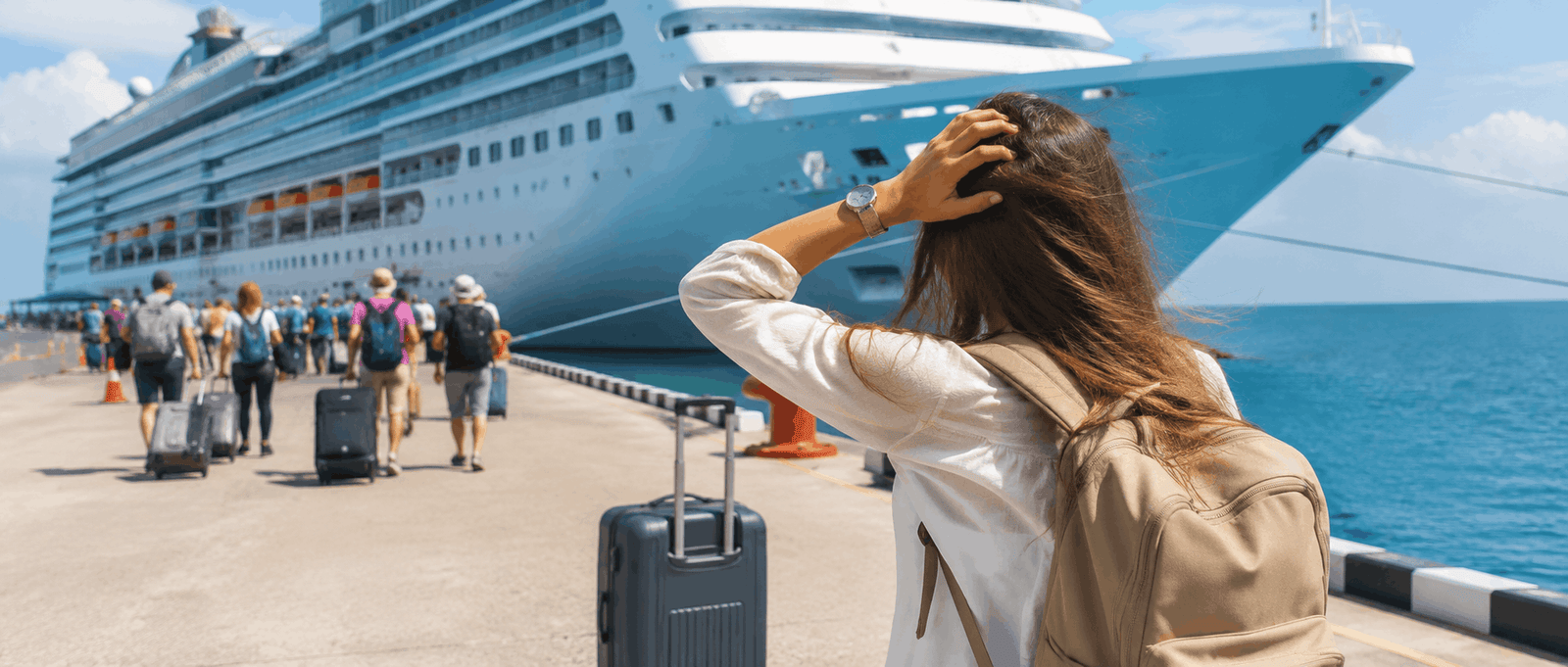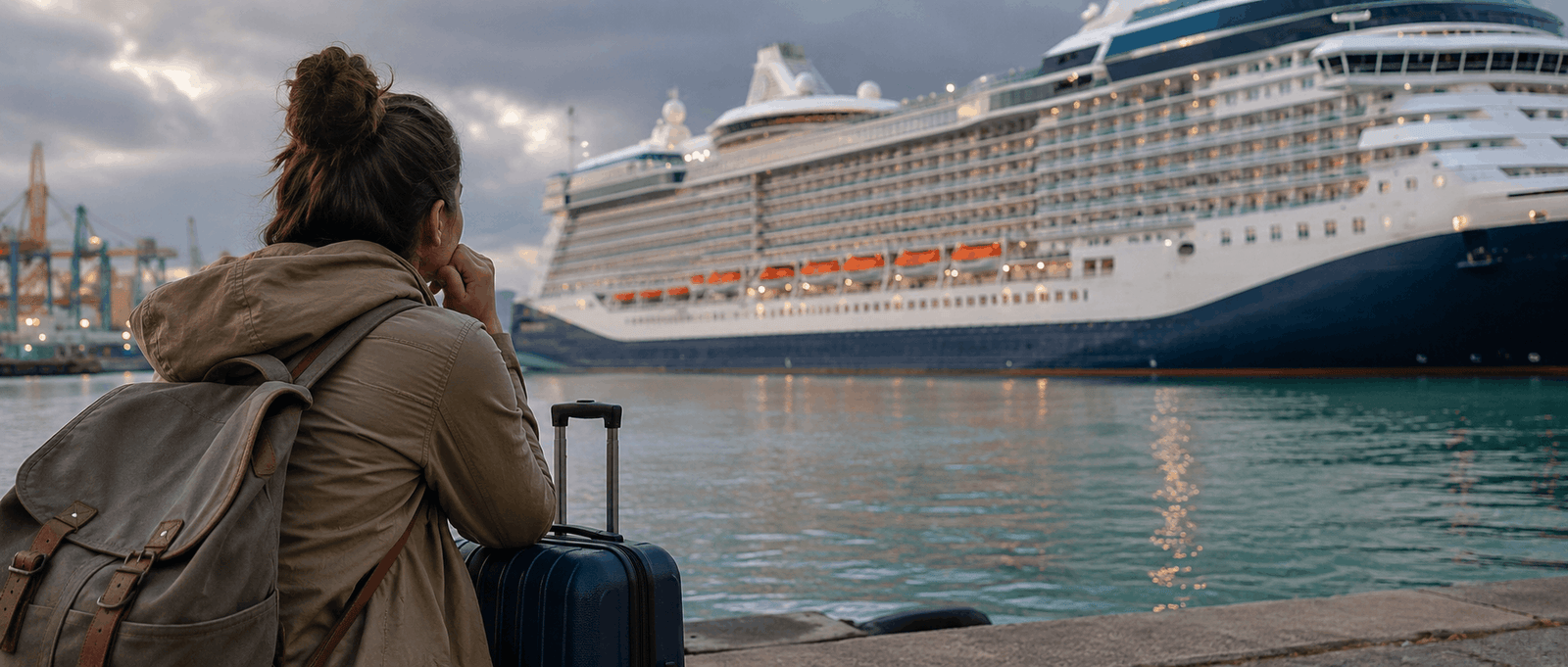
There is a moment that most solo cruisers know intimately, even if they have never spoken it aloud. It happens between booking the ticket and packing the suitcase — when excitement gives way to quiet dread. The ship suddenly feels very large. The passenger manifest feels very long. Then the question finally lands : What if I spend the trip alone?
Solo cruising is growing rapidly as more travelers choose independence over compromise. Cruise lines are responding with more solo cabins, social programs, and spaces designed for independent travelers.
The fear persists because it is normal. Entering a new environment full of strangers naturally creates uncertainty. Understanding that fear — and what the research says about it — helps solo travelers board with more confidence.
What follows is an honest look at the seven fears most solo cruisers experience, the psychology behind them, and the reality the evidence supports.
Fear One: The Loneliness That Might Not Go Away
What the fear actually is
This is the foundational fear, the one everything else branches from. It is not simply about being alone — most people who choose to travel solo are comfortable with solitude in general. It is about being visibly alone in an environment designed for togetherness. Cruise ships are architected around shared experience: shared dining rooms, shared pools, shared entertainment venues. The solo traveler moves through all of it with the awareness that their aloneness is legible to everyone around them.
Psychologists call this social visibility anxiety — the feeling of standing out in a crowd. Research on the spotlight effect shows that people greatly overestimate how much others notice or judge them in social settings.
What the evidence actually shows
The fear of persistent loneliness rarely survives contact with the ship. Cruises are naturally social environments, with shared meals, activities, and repeated interactions. Research shows solo travelers on structured trips like cruises form connections more easily because the environment encourages social interaction.
Select 62 more words to run Humanizer.
The more actionable insight is that the timing of connection matters enormously. Cruisers who board with even one connection often have a far easier first 48 hours than those arriving alone. This is why the pre-departure social ritual has become so central to modern cruising culture. Whether through a forum, Facebook group, or cruise app, these connections make the ship feel familiar before you even unpack.
The 48-hour window: Social circles on cruise ships typically form and solidify within the first two days of sailing. Travelers without connections by embarkation evening often find social groups harder to enter later. Even a brief connection before boarding can make the experience far easier.
Fear Two: Dinner for One
Why this particular fear cuts so deep
Of all the specific scenarios that solo cruisers dread, dining alone is the one that comes up most consistently. Dining alone feels more exposed because, unlike other solo activities, there is nowhere to hide from the silence around you.
The fear is partly aesthetic and partly deeply social. Humans evolved as communal eaters — sharing food is one of the oldest and most universal bonding rituals across cultures. Research from Oxford found that shared meals build social bonds more effectively than almost any other activity.The solo traveler who dreads the dining room is not being precious. They are responding to a genuine social signal that has been encoded for thousands of years.
What actually happens
Modern cruise lines now offer solo-friendly dining, including shared tables for single travelers and flexible casual options that remove much of the awkwardness.
More significantly, the dining fear is almost always resolved — often dramatically — by pre-cruise social planning. Cruisers who connect before departure often arrive with dinner plans already in place. That small advantage can shape the social experience for the rest of the trip.
Fear Three: Being Permanently on the Outside of Everyone Else’s Group
The social geometry of a cruise ship
Cruise ships have a distinct social geography. Groups often settle into familiar routines early, which can make solo travelers feel like the social space is already taken.
This fear is not about finding compatible people. It is about worrying that everyone else has already found their group, leaving the solo traveler feeling like an outsider.
The research on late social entry
The fear is understandable but empirically overstated. Research shows social groups on cruises stay open longer than most travelers expect. Cruise life creates repeated chances for casual connections to become friendships, even later in the trip.
Finding a cruise connection before departure is not about planning every moment. It is about arriving with a familiar name, a first plan, and an easier path into the ship’s social circle.
“The biggest social mistake solo cruisers make is waiting until they’re onboard to start. By that point, the window has already started closing.”
Fear Four: Safety, Vulnerability, and the Calculus of Traveling Alone
A fear that deserves to be taken seriously
Unlike some of the fears on this list, the safety concern is not a product of social anxiety or catastrophising. Solo travel carries genuine risk differentials compared to traveling with others, and minimising those differences does more harm than good. The question is not whether solo travelers should be cautious — they should — but whether the specific risks of solo cruising are as elevated as the fear suggests.
Cruise ships are among the most structurally secure travel environments available to independent travelers. Controlled access, onboard security teams, medical facilities, and the bounded geography of a ship create a baseline of safety that most land-based travel cannot replicate. The NHS’ travel safety guidance for independent travelers consistently identifies the highest-risk solo travel scenarios as those involving unfamiliar urban environments at night, unregulated transportation, and isolation from known social contacts — risks that are significantly reduced in a cruise context by the very nature of the environment.
Where the real risk lives
Shore excursions are where the safety calculus changes most meaningfully. Stepping off the ship into an unfamiliar port city — alone, navigating local transportation, with limited language and a fixed return deadline — is a genuinely different experience from the safety of the ship. This is where the social infrastructure built before boarding pays a practical dividend that goes beyond comfort.
The solo traveler who has spent three weeks cruising solo in a digital community before departure arrives at port with options. They have people to coordinate with, plans to share, and someone who knows their approximate whereabouts. The traveler who boards cold is navigating all of that alone. According to NerdWallet’s cruise planning analysis, the safety and financial benefits of sharing private shore excursions — which can cost 30 to 60 percent less than ship-sponsored tours while offering more flexibility and better local access — are only available to the traveler who has found compatible companions willing to split the cost and the experience.
Fear Five: The Single Supplement and the Financial Weight of Traveling Solo
The fee nobody likes to talk about
The single supplement is the travel industry’s least popular open secret. Most cruise lines price their cabins based on double occupancy, which means the solo traveler either pays for two berths or faces a surcharge that can add 50 to 100 percent to the base fare. According to Skift’s 2024 travel pricing analysis, the single supplement remains one of the most cited financial barriers to solo travel, and one of the primary reasons that experienced solo cruisers work so hard to extract maximum social and experiential value from every sailing.
Optimizing the investment
The financial logic of solo cruising is actually a strong argument for investing in pre-departure social planning rather than a deterrent to it. If you are already paying a premium to travel independently, then the experiences you share with others on board — the private tours you split, the specialty dinners you coordinate, the excursions you access through group pricing — represent the most direct way to increase the return on that premium.
This framing recontextualises the effort of finding cruise friends before boarding. It is not a social obligation or a cure for loneliness. It is a practical travel strategy with a measurable financial dimension. The solo traveler who uses a cruise companion app to find two or three other cruisers interested in a private food tour pays a fraction of the individual price. The traveler who boards without connections pays full price for everything, alone. The math is not complicated.
Fear Six: The Awkwardness of Starting Conversations with Strangers
Why ice-breaking feels so hard
For many solo travelers, particularly those with introverted tendencies, the prospect of initiating conversation with strangers is more anxiety-inducing than the prospect of loneliness itself. It is a very specific kind of social discomfort: the combination of rejection risk, the fear of intruding on someone else’s experience, and the pressure of having to perform sociability in a space where you are already feeling exposed.
The avoidance of this discomfort is one of the most common reasons solo cruisers end up spending more of their trip alone than they actually wanted to. They wait for someone to approach them. Nobody does — because everyone is waiting for the same thing. The social atmosphere that seemed so promising from the outside turns out, on closer inspection, to be a collection of people all hoping someone else will start.
What changes when you connect beforehand
This is the area where pre-cruise social platforms generate the most consistent, tangible improvement in the solo travel experience.
A 2023 study in Nature Human Behaviour found that people systematically underestimate how much strangers enjoy being engaged in conversation — a bias that leads to chronic under-initiation of social contact that both parties would have found rewarding. Translated to a cruise context: the person sitting next to you at trivia night almost certainly wishes someone would start a conversation, and almost certainly won’t start one themselves.
Pre-cruise digital connection bypasses this problem structurally. When a solo traveler has exchanged a handful of genuine messages with another passenger through a cruise friends app before boarding, the first in-person meeting is not a cold introduction. It is a continuation of a conversation that has already established common ground, mutual interest, and comfortable familiarity. The ice was broken weeks ago in a context where the stakes were lower and the pressure was absent. What remains onboard is simply the enjoyable part: meeting the person behind the messages.
Platforms designed specifically for this purpose — Seaya being one of the more focused examples, built around matching cruisers by sailing date and shared interests rather than simply creating a general chat group — work precisely because they reduce the cold-start problem to almost nothing. By the time two cruisers who connected through an app for cruise connection actually board the same ship, the most anxiety-inducing phase of the social process is already behind them.
Fear Seven: Missing the Full Experience Because You’re Experiencing It Alone
The FOMO specific to solo travel
The final fear is the most diffuse and perhaps the hardest to resolve with practical advice. It is the quiet conviction that certain experiences — the excursion, the sunset sail-in, the late-night conversation on a deck that feels like it belongs to no one — only count fully when they are shared with someone. That experiencing them alone constitutes some diminished version of the thing itself.
This fear is emotionally real even when it is logically questionable. Research from the University of Pennsylvania on the subjective experience of solo activities found that people consistently predict solo experiences will be less enjoyable than they actually turn out to be — particularly in contexts, like travel, where the environment itself provides constant novelty and stimulation. The anticipation of loneliness is reliably worse than the experience.
What solo cruisers actually report
The experiential record of repeat solo cruisers is instructive. The overwhelming pattern in traveler accounts is not that solo cruising feels lonely in practice — it is that it feels different from what was feared, and often considerably freer. The solo cruiser chooses their own excursion pace, joins activities based on genuine interest rather than group consensus, and approaches new people with an openness that traveling with an established social group often forecloses.
Many experienced solo cruisers describe a paradox: they meet more people on cruises taken alone than on cruises taken with friends, because traveling solo makes them more approachable and more actively social. The traveler who arrives with a packed group has little reason to reach out. The traveler who arrives knowing a few people from a make friends on cruise community — but without the social obligation of an established group — occupies a productive middle ground: the independence of solo travel with the warmth of genuine connection.
How the Experience Has Changed: The Rise of Intentional Cruise Connection
Something has shifted meaningfully in how cruisers approach the social dimension of solo sailing over the past five years, and it is worth naming directly rather than folding into general optimism about technology.
The change is not that apps exist. It is that solo travelers have become considerably more intentional about the social architecture of their trips. Where an earlier generation of solo cruisers boarded with a spirit of hopeful improvisation — trusting the ship to generate the social experience — today’s solo cruisers treat the pre-departure social window as a genuine planning opportunity, equivalent in importance to booking excursions or selecting a cabin.
The tools that support this shift range from the long-established Cruise Critic roll call forums — which have been organizing pre-cruise communities since the 1990s and remain one of the most reliable starting points for any sailing — to purpose-built platforms like Seaya, which approach the problem through compatibility matching rather than general community chat. The most effective solo cruisers tend to use both: the forum for broad pre-sailing community and the app for specific, interest-filtered cruise connection with fellow passengers whose travel style actually aligns with theirs.
According to Pew Research’s 2023 study on social technology and loneliness, digital pre-connection before shared physical experiences significantly improves the quality of those experiences — particularly for adults who describe themselves as naturally introverted. The study found that entering a social environment with established digital connections reduced the reported anxiety of social entry by a measurable margin. For solo cruisers, that translates directly into a first day that feels like arrival rather than audition.
What the Evidence Suggests You Should Actually Do
Seven fears examined. Seven fears that the research — individually and collectively — suggests are manageable, frequently overstated, and in most cases entirely preventable with one decision made at the right time.
That decision is simple: treat the four to six weeks before your sailing as a social planning window, not just a logistics window. The solo cruiser who arrives knowing a handful of names experiences a fundamentally different trip from the one who boards into the anonymous mass of 4,000 strangers. Not because the ship is different, not because the itinerary is different, but because the first 48 hours — the window in which cruising friendships form or fail to form — play out in an entirely different register.
The practical path is well-established at this point. Join the roll call community for your specific sailing on Cruise Critic. Find the Facebook group if one exists. And if you want something more targeted — a genuine cruisemate finder experience that matches you with fellow cruisers by sailing date and shared interests rather than depositing you in a general group of hundreds — a platform like Seaya is built precisely for that problem. Use the tools that exist. They were built for exactly the fears on this list.
Solo cruising is not the act of courage it is sometimes framed as. It is a completely reasonable travel choice that a growing number of people are making with increasing confidence. The fears before boarding are real, they are understandable, and the research is clear: they are almost universally worse in anticipation than in reality.
Go book the trip. Find your people before you board. And when the gangway opens on embarkation morning, walk onto that ship knowing — not hoping, knowing — that someone on the other side of it already knows your name.

For Christian, Seaya is the culmination of a career-long obsession with innovation. By leveraging his deep technical expertise to dismantle legacy constraints, Christian is transforming the way travelers connect at sea. He is dedicated to keeping Seaya at the vanguard of the “what’s next,” proving that the most powerful innovations happen when world-class tech meets a completely new frontier.
SUBSCRIBE NOW
Your Next Cruise Adventure Awaits
- News & articles
Related Blog