I’ve watched a lot of people board cruises with the same quiet hope: maybe I’ll meet some great people on this cruise trip. Some do. Many don’t — not because it’s hard, but because they spend the whole voyage waiting for it to happen instead of stepping into it.
Here’s the thing that most cruise guides won’t tell you: connection on a ship isn’t about being the loudest person at the pool bar or having some rehearsed icebreaker ready. It’s about showing up in the right places, returning to them consistently, and making the small moves that invite conversation rather than force it. This guide is built around what actually works — from the weeks before you board to the last evening at sea.
Start Connecting Before the Ship Leaves Port
The period between booking your cruise and stepping on the gangway is one of the most overlooked social opportunities in travel. Most people treat it as pure logistics — passports, packing lists, transfer arrangements. But this window is actually a goldmine if you use it well.
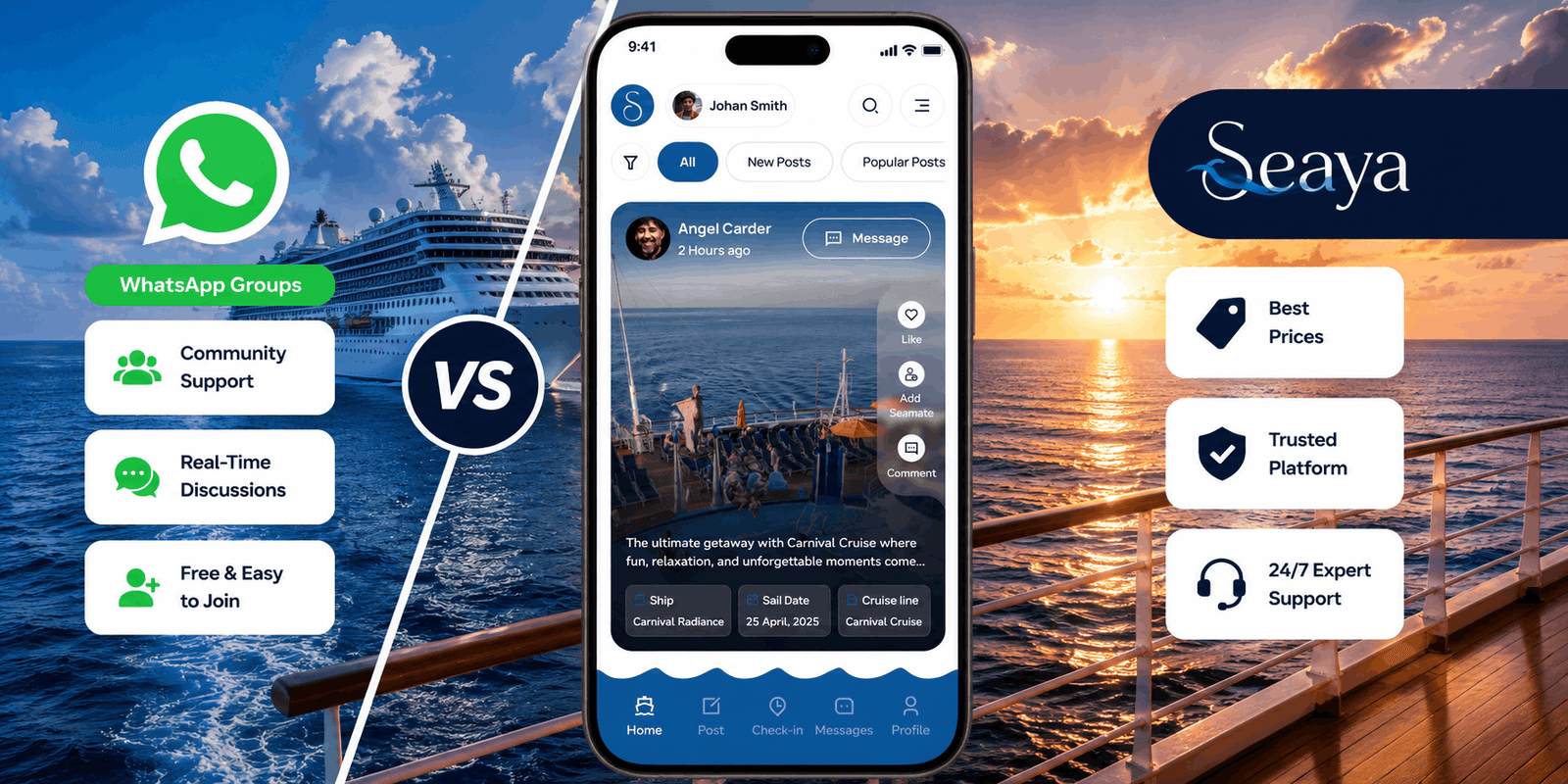
Cruise lines have long maintained online roll calls and community forums where passengers on the same sailing can connect ahead of time. These are worth joining, but they can be scattered and hard to navigate. A newer platform called Seaya takes this a step further by letting you find and connect with people on your exact ship and sailing dates — coordinating group dinners, organizing pre-excursion meetups, or simply finding someone who shares your travel style before you ever set foot on board. Getting active on something like this at least four to six weeks before departure gives you a genuine social foothold from day one.
The goal isn’t to arrive with a full social calendar already planned. It’s simply to arrive with a few familiar faces. Even one person you’ve spoken to online changes the energy of boarding day completely.
Position Yourself Where Conversation Is the Default
Not every corner of a cruise ship is equally social, and the difference matters more than most people realize. Certain spaces are designed to generate conversation; others are designed to let you disappear into your own world. If meeting people is your goal, you need to be intentional about where you spend your time.
Sit at the Bar, Not the Booth
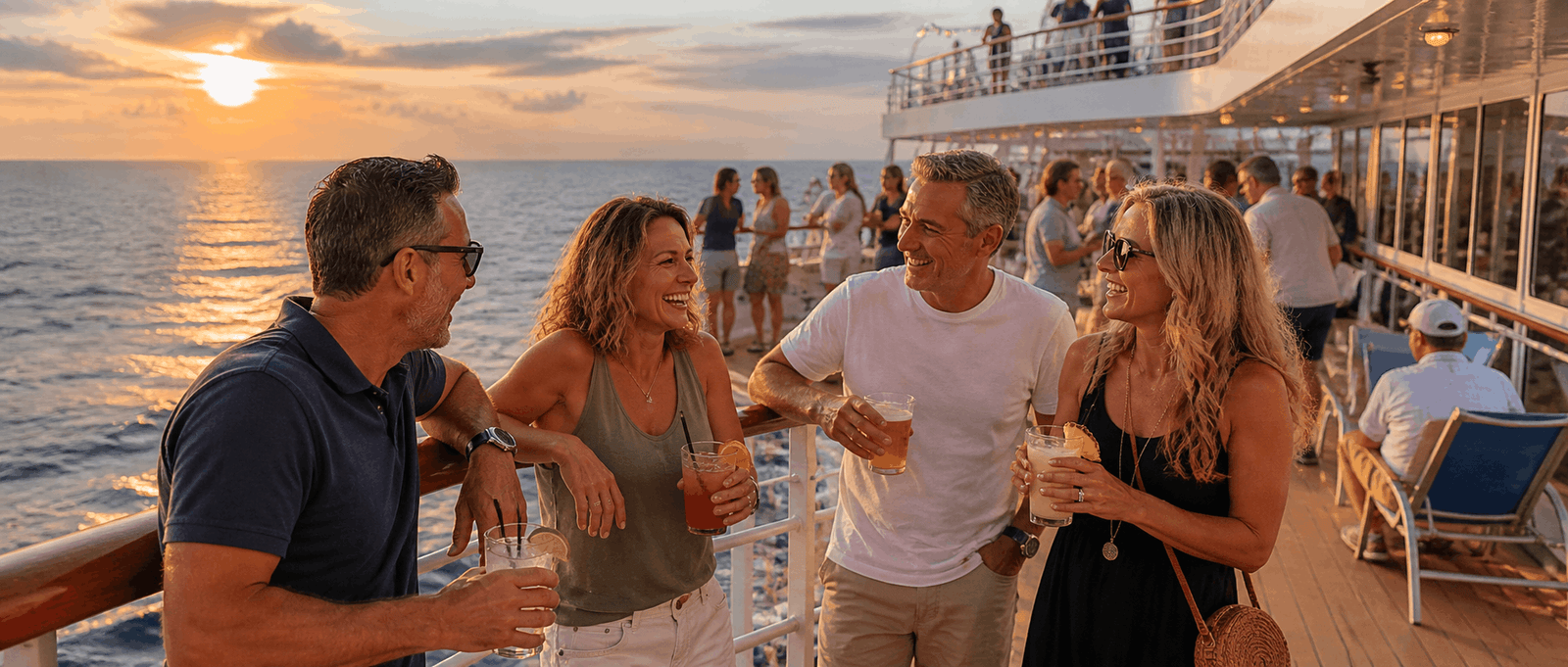
When you head to a lounge for an evening drink, the choice between a secluded booth and a seat at the bar is actually a social decision. Sitting at the bar is a universally understood signal that you’re open to interaction. Bartenders on cruise ships are some of the best social connectors you’ll find — they know everyone by day three, and they’re skilled at making introductions feel natural. Cruise industry research consistently shows that onboard bars rank among the top three spaces where passengers report forming new friendships.
Show Up to Trivia — Even If You’re Terrible at It
Trivia is the undisputed social engine of a cruise ship. The format does all the heavy lifting for you: it gives people a shared focus, a low-stakes reason to talk to strangers, and just enough friendly competition to make the interaction memorable. If you arrive solo or as a pair, ask the host to slot you into an existing team rather than forming your own. Some of the best cruise friendships begin during a heated argument about the release year of a film neither person can fully remember.
Dining Is Your Most Consistent Social Opportunity
Of all the tools available to meet people on a cruise, the dinner table is the most reliable. According to research on travel and social bonding, shared meals create a unique environment for connection because they remove the pressure of “doing” something together and replace it with the simple act of being present. On a cruise, this dynamic is amplified by the fact that you’re far from home, slightly out of your routine, and sitting next to someone who made the exact same choice you did.
If you have the option, choose traditional fixed-seating dining over “My Time Dining.” The flexibility of the latter sounds appealing on paper, but in practice it means you’ll rarely sit with the same people twice. Fixed seating at a large table of six or eight gives you the same familiar faces every evening — and it’s the repetition that builds real bonds, not any single conversation.
The questions don’t need to be clever. Where someone is from, what brought them on this particular voyage, whether they’ve sailed this itinerary before — these are enough. People generally enjoy talking about themselves when they feel genuinely listened to, and a cruise dinner is one of the few settings where there’s no excuse to rush.
It’s the Second Interaction That Actually Counts
Here is the insight that most people miss when they think about meeting new people on a cruise: the first conversation rarely does much. A pleasant exchange at the pool, a shared laugh at the welcome show — these are warm-ups, not connections. Cruise Connection happens in the second and third interaction, when recognition kicks in and the small talk gives way to something more genuine.
This means that the most important social habit you can build on a cruise is simple consistency. Return to the same lounge at roughly the same time each evening. Sit at a similar spot at the breakfast buffet. Nod to the couple you met at trivia when you pass them in the corridor. These repeated micro-interactions build a sense of familiarity faster than almost anything else, and familiarity is the precondition for real friendship.
Think of it less like networking and more like becoming a regular at your neighborhood coffee shop. You don’t force the relationship — you just keep showing up until it forms on its own.
Book the Shore Excursions That Force You to Interact
The excursions you choose will largely determine your social experience on land. A scenic bus tour is comfortable and informative, but it involves sitting in a seat staring at the view while a guide speaks into a microphone. A snorkeling trip, a cooking class, or a small-group sailing excursion is a completely different proposition. These formats put people in proximity, create shared challenges, and give everyone something to talk about that isn’t just logistics.
The person who helps you find your fins at the snorkeling briefing, or who ends up at your workstation in a local cooking class, is a far more likely future friend than the stranger two rows ahead of you on a bus. Shared adventure — even mild adventure — accelerates trust in a way that passive experiences simply don’t. It’s worth choosing the slightly more active option even when the passive one looks tempting.
Solo travelers should also look out for cruise line-organized solo meetups, which many ships now schedule on the first evening. These aren’t awkward forced-socializing sessions — they’re simply a room of people who all made the same decision to travel alone and are largely happy to meet someone. The bar for conversation is about as low as it gets.
Make the First Move — Keep It Small
One of the quieter truths about meeting people on a cruise is that most fellow passengers are also hoping to connect. They’re just waiting for someone else to go first. The threshold for that first move is much lower than it feels from the inside.
A casual invite is almost always enough: “I’m heading up to the top deck to watch the sunset if you want to join.” There’s no commitment implied, no awkwardness if they decline, and no performance required. It’s the conversational equivalent of holding a door open — an easy gesture that costs almost nothing and occasionally leads somewhere genuinely worthwhile.
The same principle applies to digital invitations before you sail. If you’ve connected with someone through a platform like Seaya or a cruise community forum, a simple “Hey, a few of us are planning to grab dinner on night two — want to join?” is far more effective than waiting for something to organically emerge once you’re all on board.
Be Approachable Without Trying Too Hard
You don’t need to be extroverted to be approachable. Research in social psychology consistently shows that non-verbal cues — eye contact, open body posture, a genuine smile — are more powerful invitations to conversation than any verbal opener. Sitting facing the room rather than the wall, putting your phone face-down occasionally, and simply looking up when someone passes are small signals that communicate availability without requiring a single word.
It’s also worth being selective about where you invest your energy. Not everyone on a cruise is looking to socialize — and that’s entirely their right. The travelers who want company tend to make it fairly obvious: they linger after activities end, they ask follow-up questions, they make eye contact when you pass. Those are your people. Focus on them rather than trying to draw out someone who is genuinely content with their own company.
A Few Practical Notes Worth Keeping in Mind
If you’re sailing with a major line like Royal Caribbean, Norwegian Cruise Line, or Celebrity Cruises, check the cruise line’s official app before you board. Most now include onboard messaging, activity schedules, and sometimes even social features that make it easier to coordinate with people you’ve met. Using these alongside a community platform like Seaya gives you both the pre-trip foundation and the on-ship tools to keep momentum going.
The 15-minute rule is also worth adopting: if you join a group and the chemistry isn’t there, give it a quarter of an hour before you politely excuse yourself. Not every social situation will click, and that’s fine. A cruise is long enough that you’ll find your people — you just need to stay patient and keep moving.
Finally, say yes to the things that feel slightly outside your comfort zone. The belly flop contest, the silent disco, the early-morning yoga on the top deck — these tend to attract the curious, the social, and the people who are actively trying to make the most of the voyage. Those are exactly the kinds of travelers worth meeting.
Conclusion
Meeting people on a cruise is genuinely one of the easier social experiences travel has to offer. The ship does an enormous amount of the work by putting interesting people in the same place for days at a time, removing the stresses of daily life, and building in repeated opportunities for interaction. Your job is simply not to squander that setup.
The habits that matter most are also the simplest ones: start connecting before you board, choose spaces and excursions that invite interaction, return to familiar places so recognition can build, and make small moves rather than waiting for the perfect moment. None of this requires you to be someone you’re not. It just requires a little intention.
A cruise vacation is, among other things, an unusual permission slip to talk to strangers without it being strange. Use that. The person sitting across from you at dinner tonight might still be in your life a decade from now — if you look up from the menu long enough to find out. For anyone who wants to get a head start before boarding day, Seaya App is a good place to begin.

For Christian, Seaya is the culmination of a career-long obsession with innovation. By leveraging his deep technical expertise to dismantle legacy constraints, Christian is transforming the way travelers connect at sea. He is dedicated to keeping Seaya at the vanguard of the “what’s next,” proving that the most powerful innovations happen when world-class tech meets a completely new frontier.
SUBSCRIBE NOW
Your Next Cruise Adventure Awaits
- News & articles
Related Blog