Key Takeaways
- Inside cabins offer the best value for travelers who spend minimal time in their room
- Ocean view cabins provide natural light and sea views at a moderate price increase
- Balcony cabins deliver the most private, flexible space but come at a significant premium
- Cabin location on the ship affects motion and noise more than most first-time cruisers expect
- Scenic itineraries (Alaska, fjords, canal transits) make balconies far more worthwhile
- Port-heavy itineraries with minimal sea days reduce the value of paying for a balcony
- Guaranteed cabin bookings can save money if exact room location isn’t a priority
- Cabins below pool decks or buffet areas are more prone to early-morning noise
- Motion sickness is best managed by choosing a midship, mid-deck cabin regardless of category
- The “best” cabin depends entirely on how you plan to spend your time on board
Picking a cruise cabin feels simple until you actually sit down to book one. Then you’re staring at a deck plan full of tiny colored boxes, wondering why an identical-looking room costs $400 more three decks up, and asking yourself whether you’ll actually care about a window once you’re out there dancing at the pool deck every night anyway.
Here’s the truth nobody tells you before your first cruise: your cabin isn’t just where you sleep. It shapes your sleep quality, your budget, how seasick you feel in rough water, how much privacy you get, and honestly, your mood on day three when the excitement of boarding has worn off and you just want a decent place to recharge. Choose well and your cabin becomes a quiet retreat you look forward to. Choose poorly and you spend the week wishing you’d paid more attention during booking.
This guide breaks down the three main cabin categories — inside, ocean view, and balcony — with real trade-offs, not marketing copy. By the end, you’ll know exactly which one fits your travel style, budget, and priorities.
Understanding Cruise Cabin Types
Every cruise ship, regardless of Cruise Line, organizes cabins into a handful of core categories. Once you understand the basic logic, the deck plan stops looking like a maze and starts making sense.
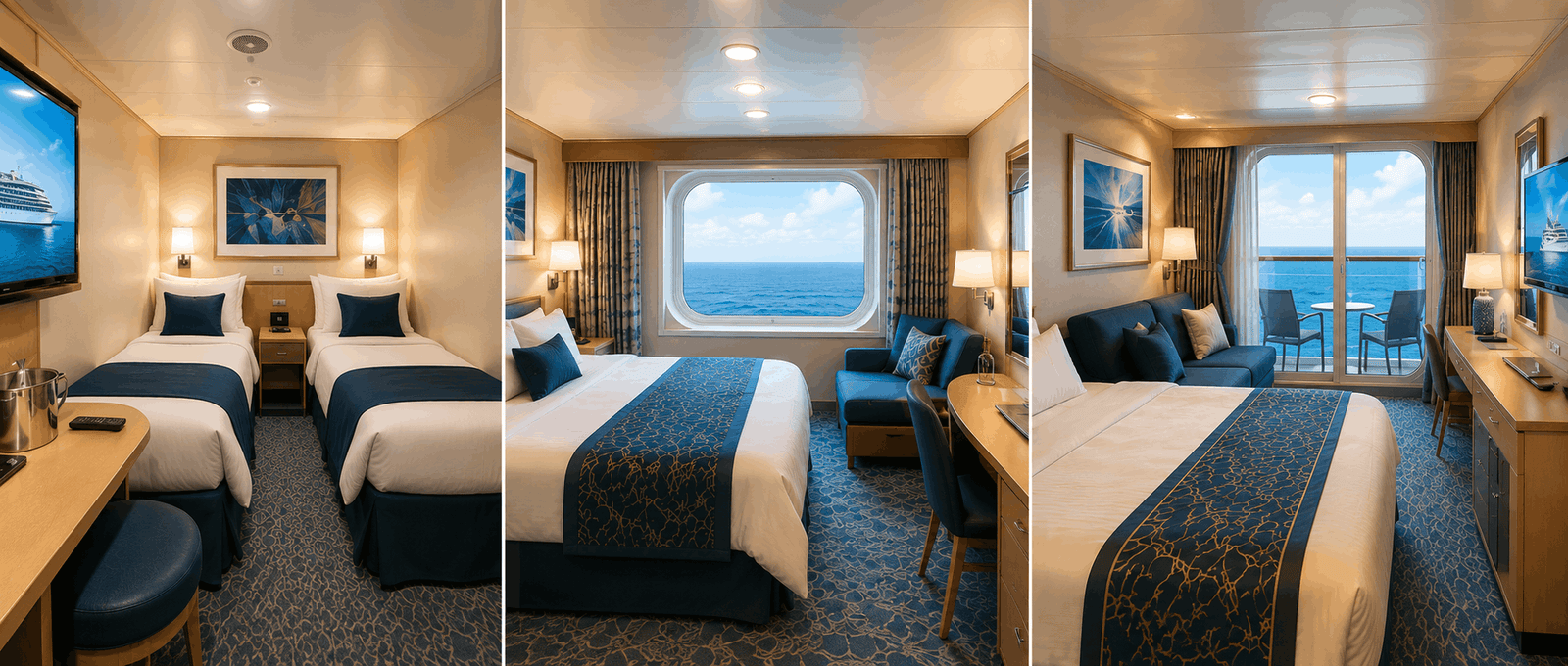
Inside cabins sit in the interior of the ship, with no window or balcony at all. They’re the smallest and least expensive option, designed for travelers who see their cabin as a place to sleep and shower rather than a space to spend the day.
Ocean view cabins (sometimes called outside cabins) include a window or porthole, giving you natural light and a view of the sea, but no door leading outside. These sit in the middle of the price and space spectrum.
Balcony cabins add a private outdoor space attached to the room, usually with two chairs and a small table. They cost more but give you a personal outdoor spot away from crowded public decks.
There are other categories too — suites, family cabins, connecting rooms — but nearly all of them are variations on these three core types with more square footage or added perks. Understanding inside, ocean view, and balcony first will make every other option easier to evaluate.
Inside Cabin
Inside cabins get an unfair reputation as the “budget compromise,” but for the right traveler, they’re genuinely the smart choice — not just the cheap one.
Advantages
- Lowest price point by a meaningful margin, often 20-40% less than an equivalent ocean view cabin
- Naturally dark, which makes them excellent for sleeping in, especially useful if you’re adjusting to time zone changes or planning late nights out
- Same size bed and bathroom as most ocean view cabins on many ships — you’re not sacrificing comfort, just the window
- Frees up budget for excursions, specialty dining, or onboard activities
Disadvantages
- No natural light means no easy way to gauge time of day or weather without checking your phone
- Some travelers feel a mild sense of disorientation or claustrophobia, particularly on longer sailings
- No way to check sea conditions from your room, which can matter to nervous cruisers
- Storage and floor space are usually the tightest of the three cabin types
Best For
Travelers who spend minimal time in their cabin, budget-conscious cruisers, groups who plan to be out exploring from morning until night, and anyone who sleeps better in total darkness.
Typical Price
Inside cabins generally run $60-120 per person, per night, though this varies significantly by Cruise deck plans, itinerary, and season. On mainstream lines like Carnival or Norwegian, you’ll often find inside cabins under $700 per person for a 7-night Caribbean sailing during off-peak months.
Money-Saving Tips
Book an inside cabin early in a “guaranteed” category (more on this below) to lock in the lowest fare, then watch for price drops or upgrade offers as the sailing date approaches. Many cruisers successfully snag a free upgrade to ocean view simply by booking guaranteed inside and letting the cruise line assign the room closer to departure.
Ocean View Cabin
Ocean view cabins are the middle child of cruise cabins — often overlooked, but a genuinely strong option for travelers who want a window without paying balcony prices.
Advantages
- Natural light throughout the day, which helps regulate your sleep cycle on longer cruises
- A view of the ocean or coastline without the added cost of an outdoor space
- Easier to judge weather and sea conditions, useful for planning excursion days
- Typically only modestly more expensive than an inside cabin
Disadvantages
- On some ships, the view is obstructed by lifeboats, equipment, or structural supports — always check the deck plan notes
- You still can’t step outside; the window doesn’t open
- Some ocean view cabins toward the front or back of the ship experience more motion in rough seas
- Not significantly larger than inside cabins on most ships, despite the added cost
Best For
Travelers who want natural light and a sea view but don’t need private outdoor space, cruisers on repositioning or scenic itineraries (like Alaska or Norway) where daytime views matter even without a balcony, and anyone booking a lower deck where balcony cabins aren’t available.
Average Cost
Ocean view cabins typically run 10-25% more than inside cabins on the same sailing, averaging $80-150 per person, per night depending on cruise line and season.
Who Should Avoid It
Skip ocean view if you’re prone to motion sickness and can’t upgrade to a balcony — a fixed window doesn’t let in fresh air, and some travelers find that combination (seeing the horizon move without feeling a breeze) actually worsens queasiness. If fresh air matters to you at all, it’s worth stretching the budget for a balcony instead.
Balcony Cabin
Balcony cabins are the most requested upgrade on nearly every cruise line, and for good reason — but they’re not automatically the “best” choice for every traveler.
Advantages
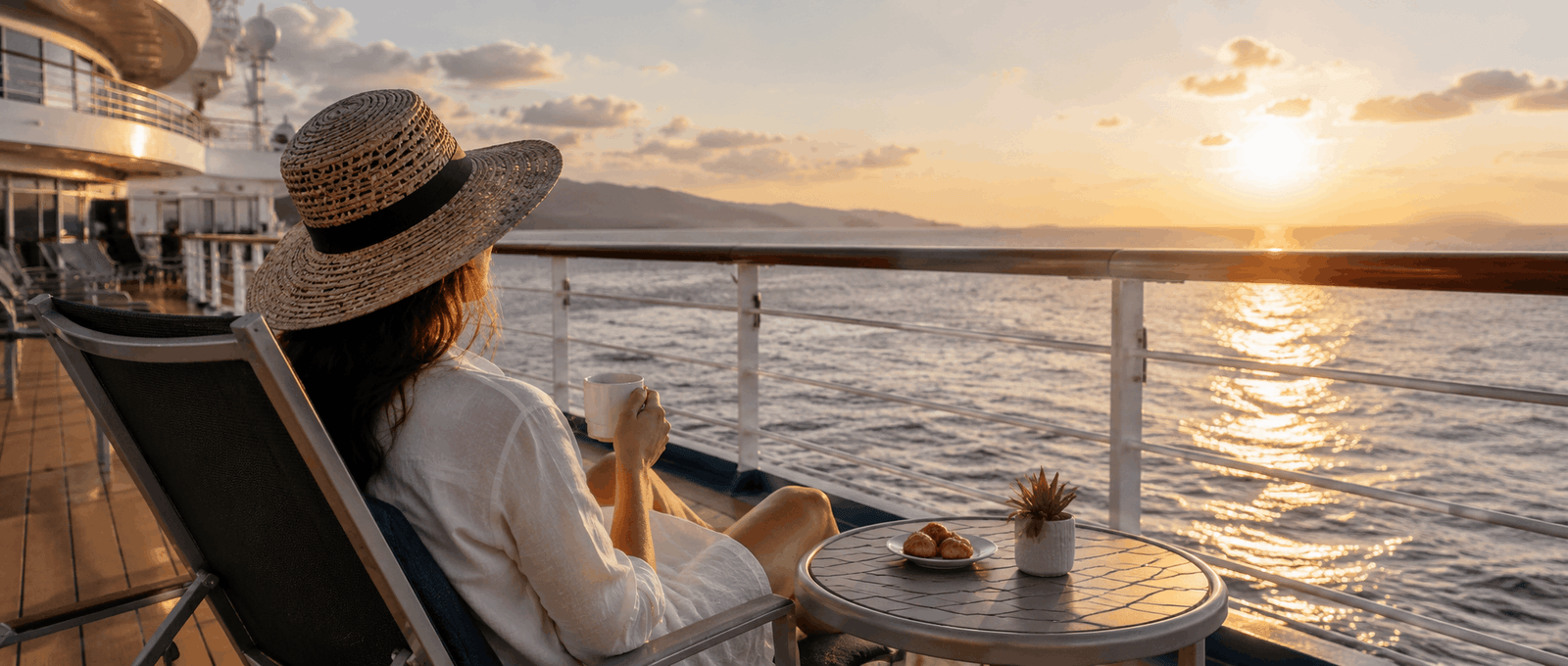
- Private outdoor space to enjoy coffee, sunrises, or sail-away without fighting for pool deck real estate
- Fresh air circulation, which genuinely helps with mild seasickness for many travelers
- More natural light and often a slightly larger overall footprint than inside or ocean view cabins
- A private space for photos, quiet reading, or watching the coastline during scenic cruising days
Disadvantages
- The largest price jump of the three categories, often 40-70% more than an ocean view cabin
- Balconies on lower decks or near ship engines can pick up more noise and vibration
- Adjoining balconies mean limited privacy — neighbors can often hear conversations
- On itineraries with many sea days and mild weather, some travelers use the balcony far less than they expected
Privacy
Most standard balconies have partial dividers rather than full walls, meaning voices carry between neighboring rooms. If privacy is a priority, look specifically for cabins with solid partition walls (common on some Royal Caribbean and Celebrity ships) rather than the perforated metal dividers used elsewhere.
Views
Balcony views vary enormously by location. Aft (back of ship) balconies often get sweeping wake views and are considered some of the best real estate on the ship. Midship balconies are more stable in rough seas. Forward-facing balconies can be exposed to wind and sea spray, which sometimes makes them less usable than expected.
Extra Cost
Expect to pay $130-250+ per person, per night for a standard balcony cabin, with premium and aft-facing balconies commanding even higher prices.
Is It Worth Paying More?
It depends entirely on how you travel. If you value quiet mornings, plan to spend downtime in your Cruise Cabin, or you’re cruising a scenic itinerary like Alaska, the balcony often earns its cost. If you’re the type who’s only in your cabin to sleep and shower, that extra few hundred dollars is usually better spent on shore excursions or specialty dining.
Side-by-Side Comparison Table
| Factor | Inside Cabin | Ocean View Cabin | Balcony Cabin |
|---|---|---|---|
| Price | $ | $$ | $$$ |
| Space | Smallest | Small-Medium | Medium-Large |
| Natural Light | None | Yes (fixed window) | Yes (open air) |
| Privacy | High (no view in/out) | High | Moderate (shared dividers) |
| View | None | Sea view, may be obstructed | Full open-air sea view |
| Value | Best for tight budgets | Good middle ground | Best for experience-focused travelers |
| Couples | Good for budget-focused couples | Solid option | Ideal for romance and downtime |
| Families | Good with connecting cabins | Decent, more light for kids | Great if budget allows |
| Solo Travelers | Excellent value | Good option | Splurge-worthy but pricier solo |
| Sea Sickness | Can worsen disorientation | Neutral | Often the most comfortable |
| Luxury Experience | Minimal | Modest | Strongest of the three |
| Best Overall | Budget & short trips | Scenic sailings on a budget | Longer or scenic cruises |
Which Cabin Is Best For…
First-time cruisers: An ocean view cabin is a solid middle ground — enough natural light to feel comfortable without committing to balcony pricing before you know how you’ll like cruising.
Families: If budget allows, balconies give kids room to spread out and a safe way to get fresh air without navigating crowded public decks. Otherwise, two connecting inside cabins often beat one cramped larger room.
Solo travelers: Inside cabins offer the best value, especially since many cruise lines now offer dedicated solo cabins at reduced single-occupancy rates.
Couples: Balcony cabins are consistently the most popular choice for couples, particularly for anniversaries, honeymoons, or milestone trips where the private space adds real value.
Luxury travelers: Look beyond standard balconies toward suites, which add butler service, priority boarding, and larger balconies — but the core “balcony vs. no balcony” logic still applies underneath the suite tier.
Budget travelers: Inside cabins, booked as a guaranteed category, consistently deliver the lowest total cruise cost.
Senior travelers: Ocean view or balcony cabins on midship, mid-deck locations minimize motion and stairs while still providing natural light and easier orientation.
Remote workers: Ocean view or balcony cabins are worth the investment — natural light matters more than people expect when you’re working for several hours a day at sea.
People prone to seasickness: Balcony cabins with fresh air access, located midship on a lower-to-mid deck, tend to be the most comfortable. Avoid cabins at the very front or back of the ship.
Common Cruise Cabin Mistakes
Booking the cheapest room without considering your needs. Saving $200 upfront isn’t a win if you spend the week feeling disoriented or claustrophobic because you didn’t think through how much time you’d actually spend in the cabin.
Choosing cabins below noisy public decks. Rooms directly under pool decks, sports courts, or buffet areas often deal with early-morning furniture-dragging noise. Check deck plans for what’s directly above your cabin.
Ignoring cabin location on the ship. Forward and aft cabins experience more motion than midship cabins. If you’re even mildly prone to seasickness, this detail matters more than cabin category.
Not considering motion at all. New cruisers often focus entirely on price and view, forgetting that deck level and position affect how much you’ll feel the ship moving — especially on ships crossing open ocean rather than sailing calmer coastal routes.
Booking without researching the ship layout. Every ship is different. A “balcony cabin” on one ship might be a spacious retreat, while the same category on an older ship in the same cruise line’s fleet could be noticeably smaller. Always check ship-specific deck plans, not just the general cabin description.
Money-Saving Tips
When to upgrade: Upgrade to a balcony if your itinerary includes scenic cruising days (Alaska’s Inside Passage, Norwegian fjords, transiting the Panama Canal) where the view genuinely adds to the experience.
When not to pay for a balcony: Skip it on itineraries with mostly port days and minimal sea days — you’ll be off the ship exploring most of the time anyway, so the balcony gets little use.
How to get better cabins for less: Book early for the best selection, or book last-minute if you’re flexible, since cruise lines often discount unsold cabins in the final weeks before sailing.
Guaranteed cabins: A “guaranteed” (GTY) booking lets the cruise line assign your specific cabin within a category, usually at a discount. You know your cabin type but not the exact room until closer to sailing — a good option if location isn’t a top priority for you.
Upgrade offers: Many cruise lines send email offers to bid on a cabin upgrade in the weeks before departure. These “upsell” programs can land you a balcony for a fraction of the standard price difference.
Travel agent promotions: Cruise-specialized travel agents often have access to group rates, onboard credit, or cabin upgrades not available when booking directly. It costs nothing extra to compare.
Expert Recommendation
There’s no single “best” cabin — only the best cabin for how you actually travel. If your trip revolves around excursions, nightlife, and onboard activities, an inside cabin will serve you perfectly well and free up your budget for experiences. If you want natural light without paying premium prices, ocean view hits a comfortable middle ground. And if your cruise includes scenic sailing days, longer itineraries, or you simply value a private outdoor retreat, a balcony is one of the few cruise upgrades that consistently delivers on its promise.
The mistake isn’t choosing “wrong” — it’s choosing without thinking through how you’ll actually spend your days at sea.
How Seaya Makes Your Cruise Better
Picking the right cabin sets up your physical comfort for the week. But comfort is only part of what makes a cruise memorable — the people you meet often matter just as much as the room you sleep in.
This is where a platform like Seaya comes in handy before you even board. Instead of waiting until day one to strike up conversations at the pool or in the dining room, Seaya lets you connect with other passengers on your same sailing ahead of time. A few ways this can shape your trip:
- Meet people before your cruise, so you’re not starting from scratch once you’re on board
- Plan activities together, from trivia teams to dinner groups
- Share shore excursions, which can reduce per-person costs on private tours
- Find travel companions if you’re cruising solo but want company for certain activities
- Connect with travelers on the same sailing who share your interests, whether that’s scuba diving in port or exploring the ship’s specialty restaurants together
None of this replaces the spontaneity of meeting people organically on board — but for travelers who want a head start, especially solo cruisers or families looking for playmates for their kids, it’s a practical way to make the most of a trip you’ve already invested time and money into planning.
FAQs
Is a balcony cabin worth the extra money?
It depends on your itinerary and habits. On scenic routes or longer cruises, most travelers find it worth the cost. On short, port-heavy trips, the value is less clear since you’ll spend limited time in the cabin anyway.
Are inside cabins too small?
Not usually. Inside cabins are typically only slightly smaller than ocean view cabins on the same ship — the biggest difference is the absence of a window, not overall square footage.
Which cabin is best for sea sickness?
A balcony cabin located midship on a lower-to-mid deck tends to be most comfortable, since fresh air and a stable horizon view both help reduce symptoms.
Is an ocean view cabin better than an inside cabin?
“Better” depends on priorities. Ocean view adds natural light and a sea view for a moderate price increase, but doesn’t add meaningfully more space or private outdoor access.
Which cruise cabin offers the best value?
For most travelers, a guaranteed inside cabin offers the strongest value, especially on shorter itineraries where you’ll spend limited time in the room.
What deck should I book?
Midship, mid-deck cabins offer the most stability in rough seas and easy access to elevators and public areas without excessive walking.
Are balcony cabins noisy?
They can be, especially with partial dividers between neighboring balconies. Look for cabins with solid partition walls if privacy and quiet are priorities.
Can I upgrade my cabin after booking?
Yes, in most cases. You can request an upgrade directly, wait for an upsell offer via email, or ask a travel agent to check availability closer to your sailing date.
Which cabin is best for first-time cruisers?
An ocean view cabin is a reasonable middle ground, letting new cruisers experience natural light and sea views without committing to balcony pricing on their first trip.
Are guaranteed cabins worth it?
Yes, if location within the category isn’t important to you. Guaranteed bookings often come at a discount, and sometimes result in a complimentary upgrade.
Which cabin is best for solo travelers?
Inside cabins, particularly dedicated solo cabins offered by several major cruise lines, provide the best value without the traditional single-occupancy surcharge.

For Christian, Seaya is the culmination of a career-long obsession with innovation. By leveraging his deep technical expertise to dismantle legacy constraints, Christian is transforming the way travelers connect at sea. He is dedicated to keeping Seaya at the vanguard of the “what’s next,” proving that the most powerful innovations happen when world-class tech meets a completely new frontier.
SUBSCRIBE NOW
Your Next Cruise Adventure Awaits
- News & articles
Related Blog